
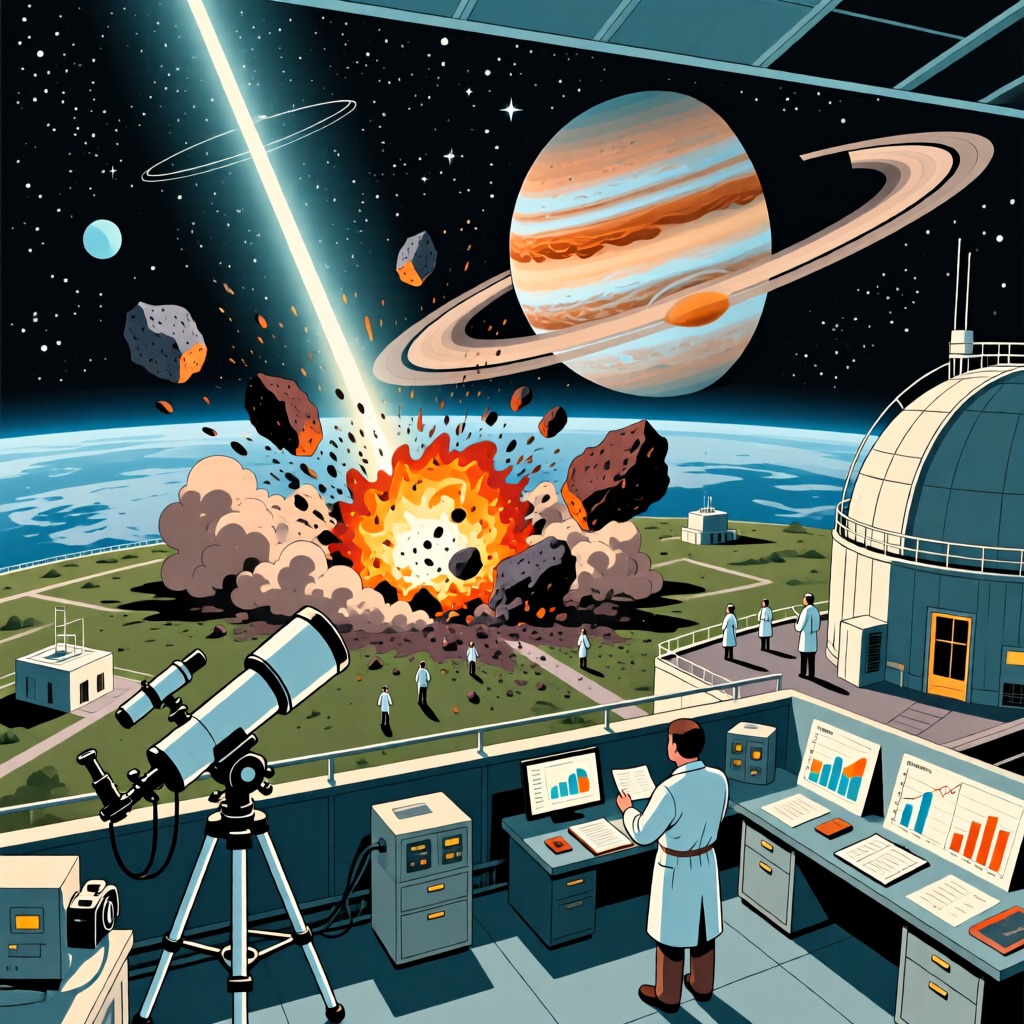

Did a planetary collision destroy a highly advanced prehistoric civilization? This idea has gradually gained traction in academia since the 1990s, primarily due to the dramatic "space kiss" that occurred in July 1994.
In July 1994, the Shoemaker-Levy 9 comet, approximately 6 kilometers in diameter and with a density of 1 gram per cubic centimeter, was torn apart into 21 fragments by Jupiter's immense gravity and collided with the planet at a speed of about 60 kilometers per second. On July 17, South African astronomers were the first to observe the impact of the first fragment on Jupiter. Subsequently, the Shanghai She Shan Observatory successfully captured images of the comet's collision with Jupiter. On July 19, the world's largest astronomical telescope, located at the summit of Mauna Kea in Hawaii, recorded the impact of the largest fragment, which was 3.2 kilometers in diameter and released energy equivalent to 25 trillion tons of TNT. After the impact, Jupiter's surface displayed a massive dark spot, leaving a black scar with a diameter of 30,000 kilometers. On the 21st, the 14th, 15th, and 16th fragments struck the same region in succession, creating an even more spectacular scene. Finally, at 4:06 PM on the 22nd, the last fragment hit, marking the end of this once-in-a-millennium celestial phenomenon that lasted six days.
The total energy released by this collision was equivalent to one billion times the energy of the atomic bomb dropped on Hiroshima during World War II, altering Jupiter's appearance and leaving deep craters. Although Jupiter is on average about 630 million kilometers away from Earth, the immense energy released during the collision and the dramatic changes in Jupiter's atmosphere and surface had almost no impact on our planet. But what if this collision had occurred on Earth?