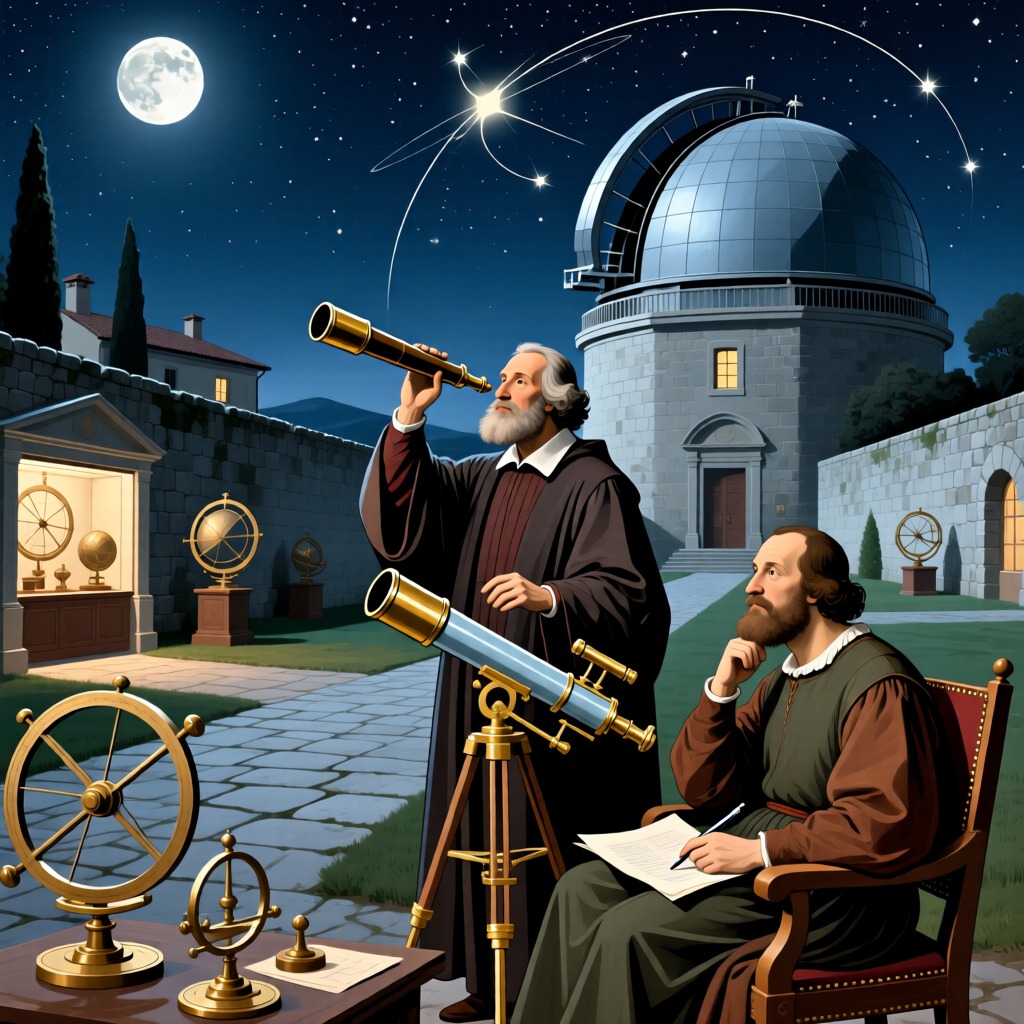
Throughout history, humanity has sought to understand the mysteries of the universe. The ancient Greek scholar Ptolemy proposed the geocentric theory, positing that the Earth is at the center of the universe, with the sun and other celestial bodies revolving around it. However, as science progressed, the Polish astronomer Copernicus introduced the heliocentric theory, asserting that the sun is the center of the universe, with the Earth and other planets orbiting it. Ptolemy's geocentric model dominated for centuries during the Middle Ages until Copernicus's theories challenged this traditional view. Copernicus's research was influenced by Renaissance thinkers, particularly figures like Leonardo da Vinci and Novara. His work, "On the Revolutions of the Celestial Spheres," fundamentally altered humanity's understanding of the cosmos. Although many at the time still adhered to the geocentric view, Copernicus's perspective eventually gained widespread acceptance. With advancements in technology, new models of the universe have emerged, suggesting that the universe itself may not have a center and is continuously expanding. This notion, while intriguing, also faces numerous challenges and questions.
The Controversy Between Ptolemy's Geocentric Theory and Copernicus's Heliocentric Theory