
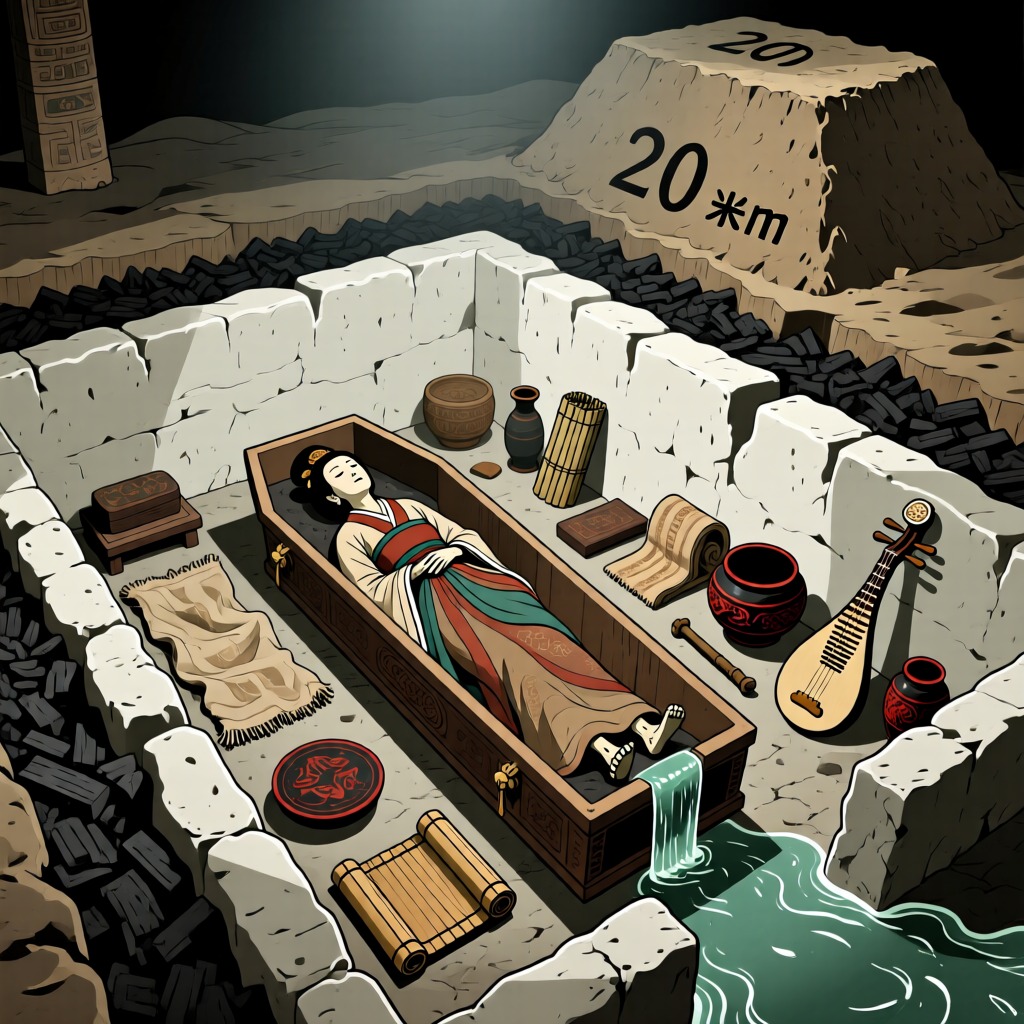

In 1972, a female corpse was unearthed from the ancient tomb of Mawangdui in Hunan, China, shocking the world. Despite being over two thousand years old, the corpse retains its complete form, with a vibrant complexion and intact internal organs, even the food in her stomach is still clearly visible. What allows this ancient corpse to remain uncorrupted for a millennium?
Typically, corpses in ancient tombs either decay or become mummies. The reasons the Mawangdui female corpse has not decayed are:
1. Effective embalming treatment. The liquid in the coffin contains a large amount of ethanol, mercuric sulfide, and acetic acid, indicating that the corpse underwent mercury treatment and other soaking processes.
2. Deep burial. The tomb is located 16 meters underground, with over 20 meters of earth above, isolating it from external air, moisture, and bacteria.
3. Tight sealing. The tomb is surrounded by a layer of white clay, lined with charcoal, and compacted with various soils, blocking out the atmosphere and light, while maintaining a relatively constant temperature.
4. Air exclusion. The tomb is nearly in a vacuum state, allowing anaerobic bacteria to thrive, producing combustible methane gas, which increases the pressure inside the tomb, aiding in preservation.
5. Naturally formed coffin liquid. The liquid outside the coffin is about 40 centimeters deep, while the liquid inside is about 20 centimeters deep, formed from a mixture of white clay, charcoal, and small amounts of moisture and water vapor from the wood, preventing decay and maintaining the elasticity of soft tissues.