
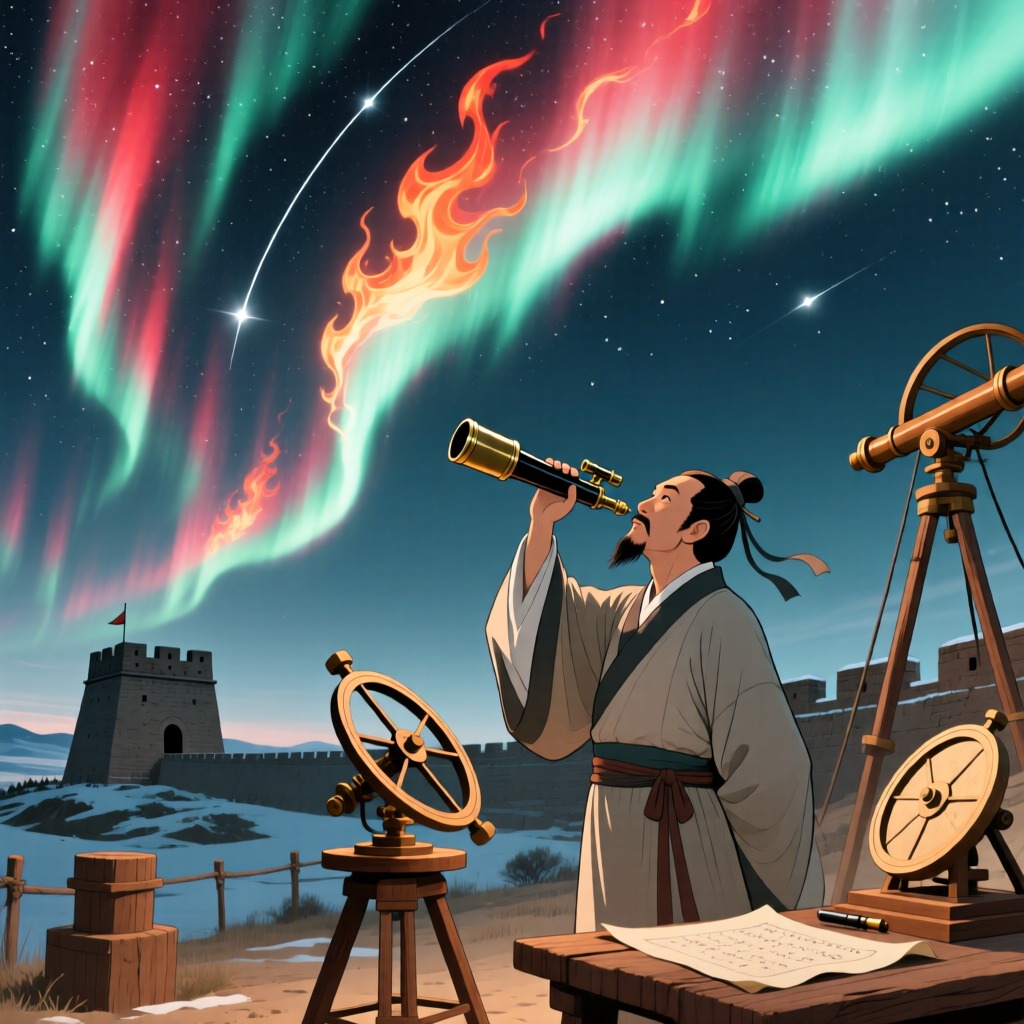
On a night in 1950, soft red and green arcs of light shimmered in the northern sky, and people witnessed this dazzling spectacle. The aurora is unpredictable, sometimes resembling dancing ribbons, at other times fiery flames, or even a giant umbrella hanging in the sky. In 1957, similar phenomena were observed in areas like Mohe and Huma in Heilongjiang, China. The aurora is a rare natural phenomenon, with only 53 recorded instances in Chinese history.
In 1988, the miracle of the aurora was witnessed again in Mohe County, Heilongjiang. It began with a bright spot on the horizon, which then rose along a W-shaped curve, forming a beautiful light band. The aurora is not only stunning but also destructive, capable of disrupting communications and transportation, and even causing power system failures. For centuries, countless explorations have been made into the causes of the aurora, yet many mysteries remain unsolved.
Ancient people had various interpretations of the aurora; for instance, the Eskimos believed it was a torch, while the Romans viewed it as the dance of the goddess of dawn. Soviet scientist Mikhail Lomonosov discovered through experiments that the aurora is caused by electrical discharges in the high-altitude atmosphere. The occurrence of the aurora is closely related to solar activity, as streams of charged particles released by the sun collide with the Earth's atmosphere, producing light. But why does the aurora only appear at the poles? This is due to the Earth's magnetic field, which causes solar wind particles to form circular halos above the poles.
Although the secrets of the aurora have not been fully unveiled, scientists continue to explore. Monitoring and studying solar winds are ongoing in hopes of uncovering more mysteries about the aurora.