
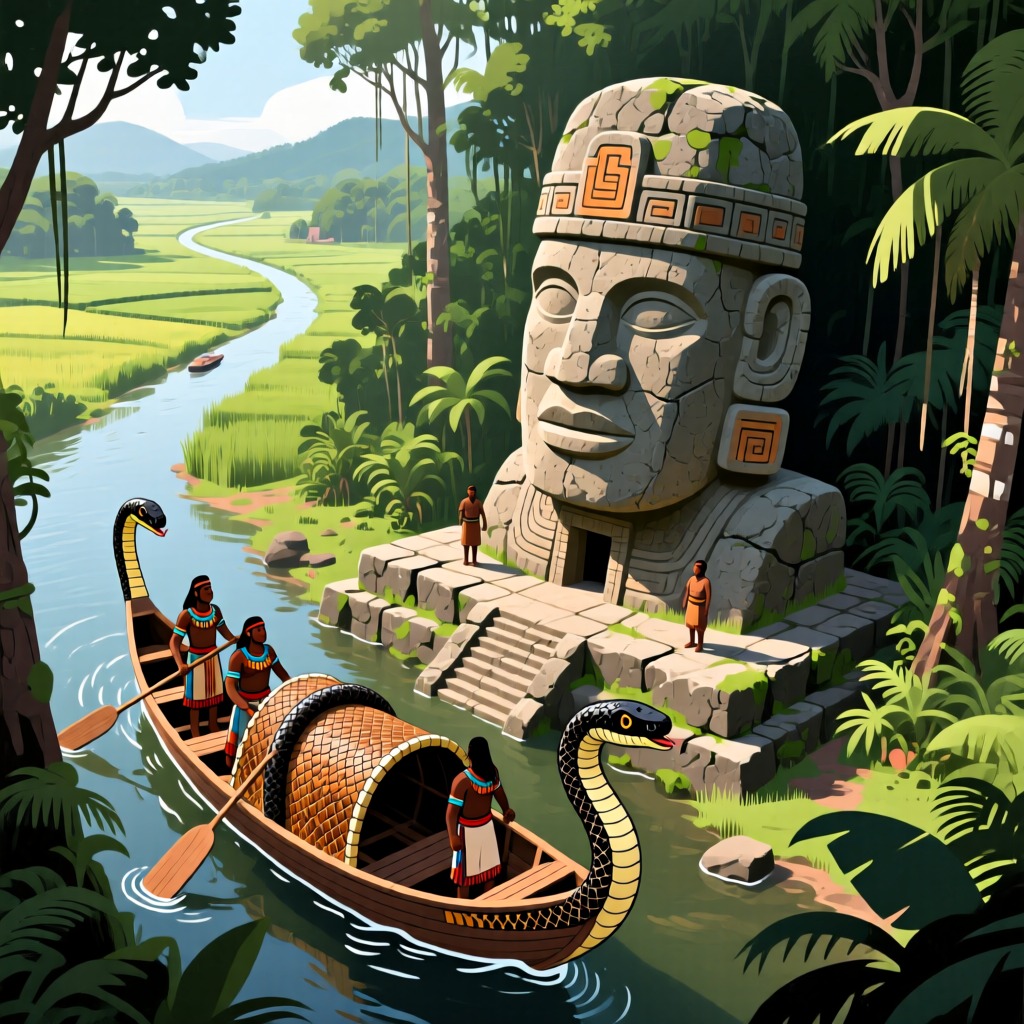

The Olmec civilization dates back to around 2000 BC, yet this ancient culture vanished 1500 years before the rise of the Aztec Empire. Often referred to as the "rubber people," they are believed to have inhabited the rubber-producing regions along the Gulf of Mexico. The Olmecs left behind many beautiful legends, such as the story of Quetzalcoatl and his disciples arriving by boat in Mexico. The archaeological remnants of this legendary civilization are primarily found near the Coatzacoalcos River, particularly in sites like La Venta, San Lorenzo, and Tres Zapotes, where numerous typical Olmec sculptures have been unearthed.
Among these, the most famous are the colossal stone heads, weighing up to 30 tons and standing about 1.8 meters tall, intricately carved with proportionate facial features. Many of these statues exhibit characteristics reminiscent of African men, including helmets, jaw bands, ear piercings, broad noses, and thick lips. Archaeologists have discovered that, despite the absence of African Black people in the Americas 2000 years ago, the skeletal remains left by the Olmecs show distinct African traits. These stone heads are not merely self-portraits; they hide unresolved mysteries.
Mainstream academia holds that the Americas were isolated from the outside world before 1492, but some scholars suggest that the Olmec statues could be the work of the Phoenicians, who may have reached the Americas across the Atlantic as early as 1000 BC. However, no artifacts from these Phoenicians have been found in Olmec settlements, complicating the origins of Olmec culture even further. The rise and fall of the Olmec civilization remains a perplexing enigma for historians and scientists today.