
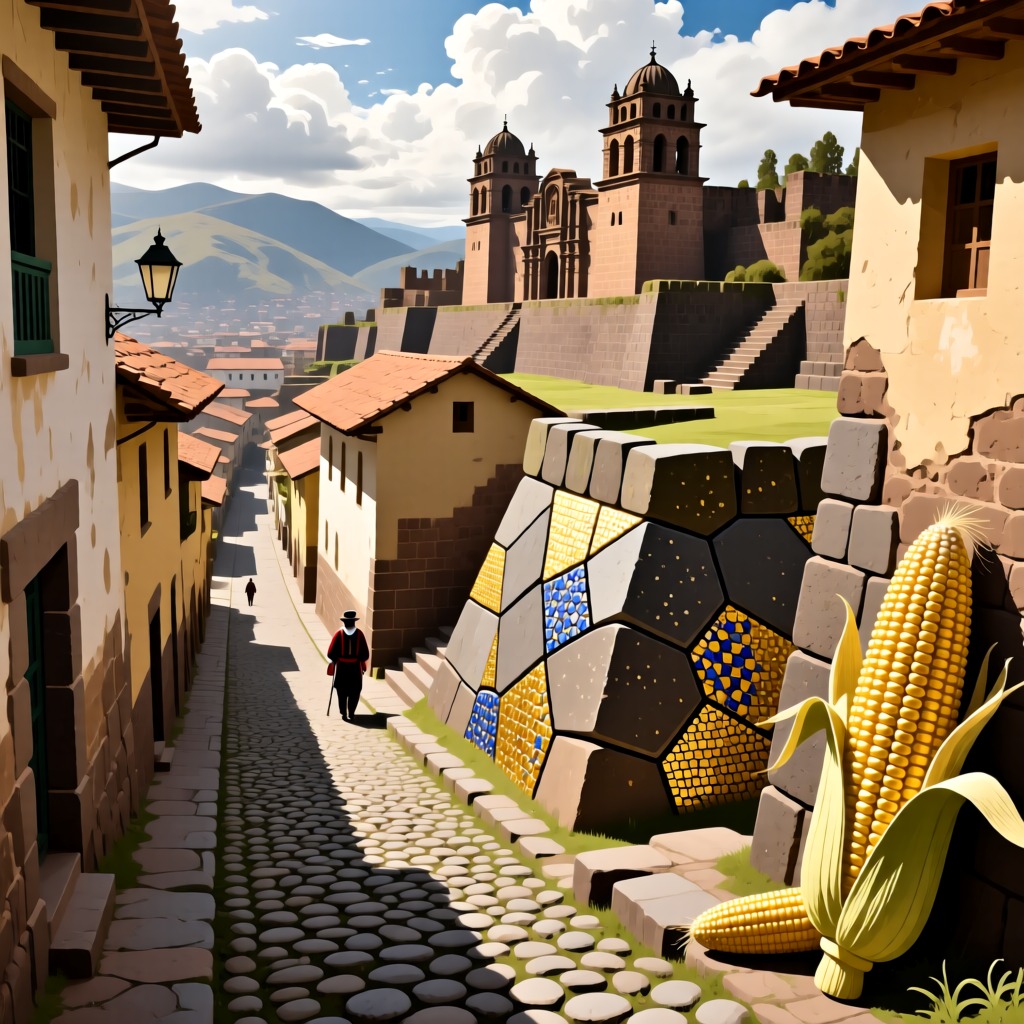

A few days after leaving the Nazca Plateau, my companion Sansa and I arrived in Cusco, eager to explore the Coricancha Temple, which was built before the arrival of the Spaniards. This temple has long vanished, leaving only the Santo Domingo Church that was constructed on its foundations. As we approached the church's entrance, I envisioned the Inca temple that was once adorned with over 700 pieces of gold. It is said that golden corn was cultivated here, reminiscent of Solomon's Temple in Jerusalem. Two earthquakes in 1650 and 1950 destroyed the church, yet the Inca-style foundations and lower walls remain intact. Today, only a few polygonal stones and faint remnants of the original design are left for future generations to ponder.
We wandered through the narrow cobblestone streets of Cusco, discovering that the Spaniards had not only left behind the church but also many colonial-style buildings throughout the city. Spacious colonial homes stood on the hillsides, their soft colors resembling crayon drawings. However, most of these houses were built on Inca foundations, with some even mimicking the design of the Coricancha Temple. In a narrow alley called 'Hatunrumiyoc,' I paused to admire the intricate mosaics made from countless stones embedded in the walls. These stones, varying in shape and size, fit together perfectly, showcasing remarkable architectural skill.
