
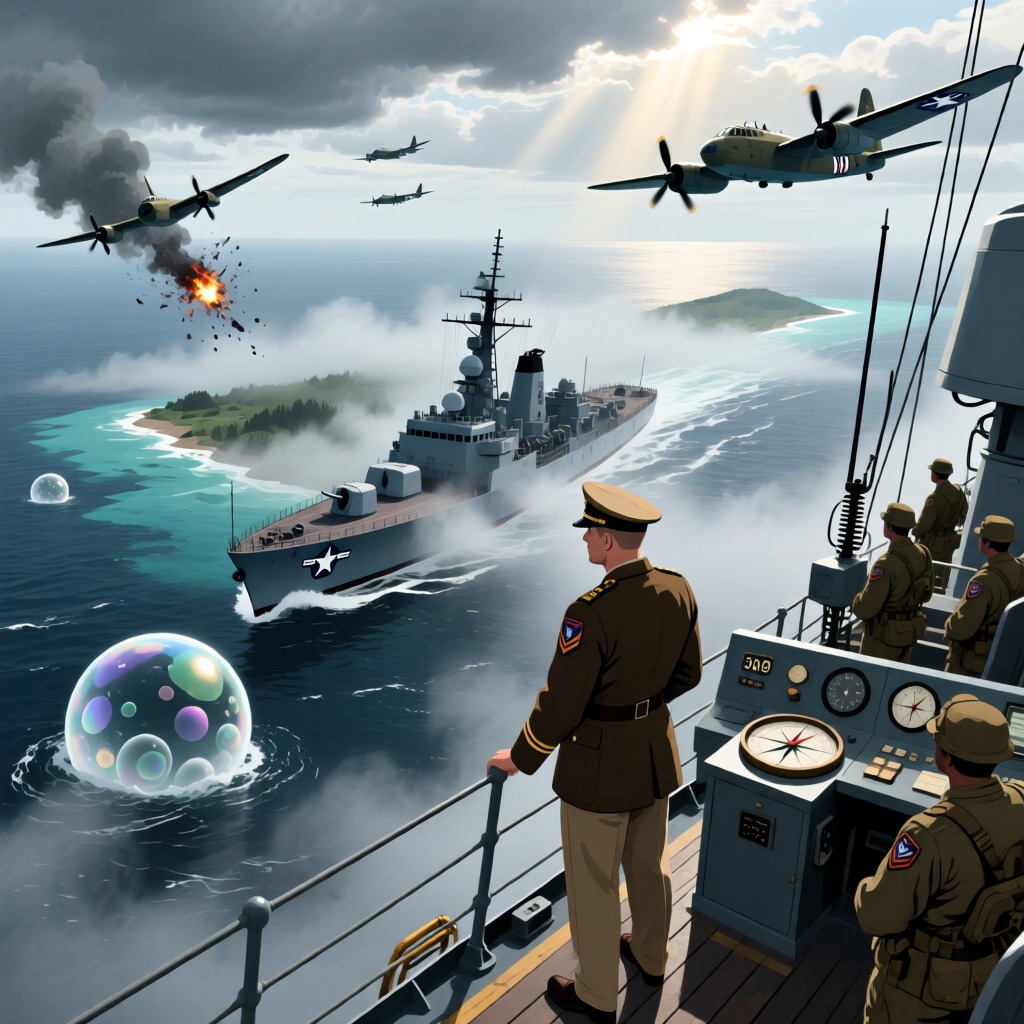

The Bermuda Triangle, located in the western Atlantic Ocean between Florida, Puerto Rico, and the Bermuda Islands, has been notorious for frequent maritime and aerial disasters since the 20th century, earning it the nickname "The Devil's Triangle." Numerous ships and planes have mysteriously vanished in this area, leaving behind an endless array of enigmas.
In 1919, the U.S. Navy ship USS Cyclops disappeared without a trace after passing through this region, resulting in the loss of all 309 crew members. In 1945, five U.S. Navy Avenger bombers encountered trouble in this area during a training mission, leading to the deaths of 14 crew members. Even more perplexing, the rescue plane sent to find these missing aircraft could not locate any wreckage.
In this maritime zone, vessels and aircraft often vanish suddenly, compasses and radio equipment fail, and strange light and fog phenomena have been reported. Since 1840, over a thousand accidents have occurred in this region.
Starting in the 1950s, scientists have proposed various explanations, including oceanic whirlpools, reverse tornadoes, clear-air turbulence, anomalous gravitational fields, and even UFO involvement. In 1990, researcher Davidsson introduced the "underwater gas" theory, suggesting that large underwater oil fields in the Bermuda Triangle could form hydrates under specific conditions. If environmental changes occur, these hydrates may decompose, releasing significant amounts of natural gas, which could lead to the disappearance of ships and planes.
Research on the "Death Triangle" continues, and similar mysterious maritime areas have been discovered in the Pacific and Indian Oceans, most of which are located along the 30-degree latitude line.