
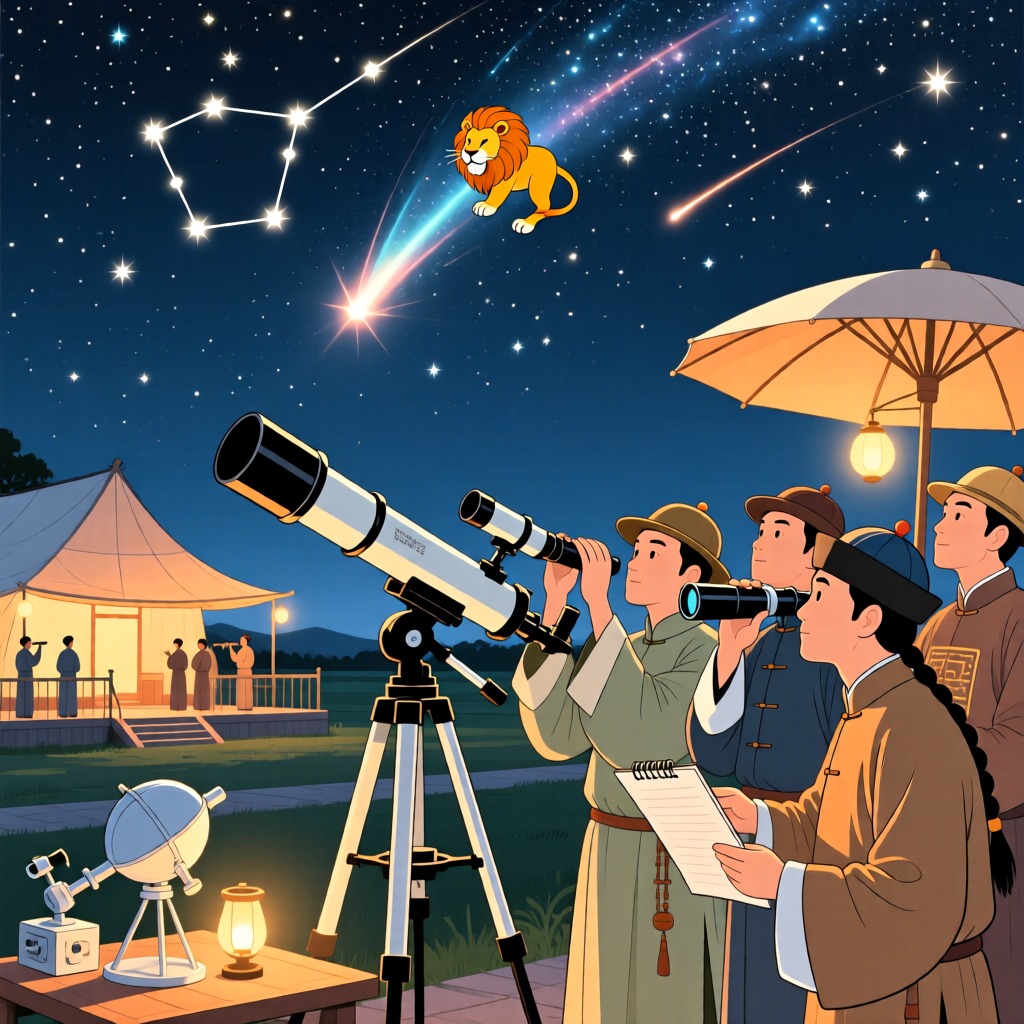

If the return of comets excites us, then meteor showers truly stir our hearts. The "Leonids Meteor Shower" captured the attention of astronomy enthusiasts worldwide when it erupted on November 18, 1998. However, the spectacular display that people anticipated did not arrive as expected; the meteor shower occurred earlier than planned, bringing unexpected surprises to observers.
"After midnight on November 18, 1998, people looked up at the starry sky with high hopes, yet they were unable to witness the grand spectacle of the 'Leonids Meteor Shower.' It turned out that this meteor shower had already begun on the morning of the 17th, peaking at 12:30 PM Beijing time." On clear nights in Asia, bright meteors and fireballs were still visible, especially in Qingdao and Kunming, where hundreds of meteors were observed.
"Enthusiastic observers could only see dozens of meteors with the naked eye on the 18th." Despite this, the early eruption of the meteor shower allowed people to experience the mystery and unpredictability of nature. The Qingdao Observatory and the Radio Astronomy Observation Station recorded a large number of meteors in the early hours, including fireballs that streaked across the sky, leaving long trails of light, resembling fireworks in the heavens.
Although the observation results were disappointing, they sparked a great interest in astronomical knowledge. Astronomy is no longer seen as an esoteric subject but has become a scientific phenomenon that the public can understand and appreciate. This also prompted astronomers to reflect on the accuracy of prediction timings, further advancing the field of astronomy.