
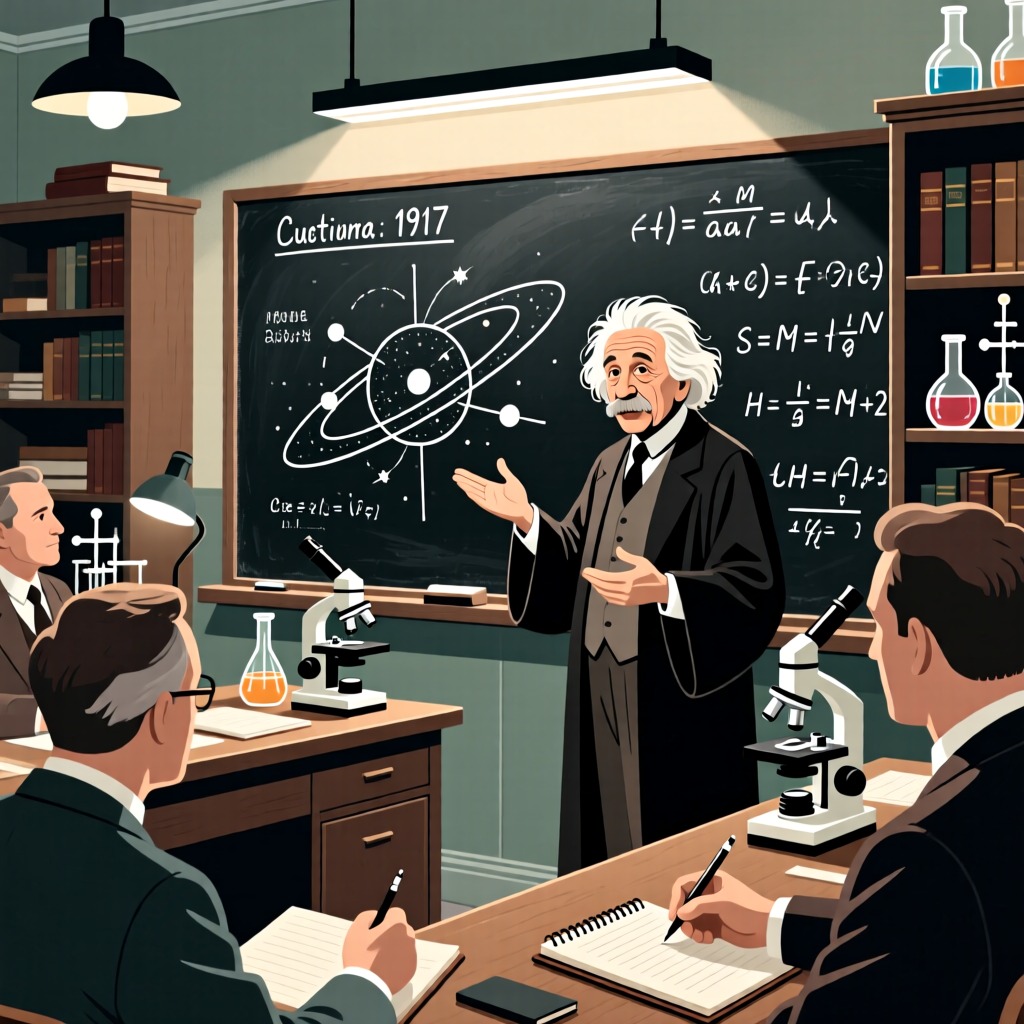

Einstein's cosmological model is a concept based on the theory of general relativity. In 1916, Einstein established this theory, which posits that there is no absolute space and time in the universe; rather, space and time are influenced by matter, and gravity is a result of the curvature of space. In 1917, Einstein applied this theory to cosmology, proposing a static, homogeneous, and isotropic universe model known as the Einstein cosmological model. At the time, scientists widely believed that the universe was at rest, but Einstein introduced the 'cosmological constant' to maintain the stability of his model. However, a few years later, upon learning about the expansion of the universe, Einstein regretted adding this 'cosmological constant' to his model.
The Einstein cosmological model can be visualized as a two-dimensional sphere within a three-dimensional space, having a finite area but no boundaries or center, and remaining in a static state. This model reveals the mysteries of the universe and provokes profound contemplation about the nature of the cosmos.