

The mystery of comets has shrouded them in a veil of fear and intrigue throughout history. In Chinese folklore, they are referred to as 'broom stars' and are often seen as omens of disaster. The appearance of Halley's Comet in 1066 coincided with Duke William of Normandy's invasion of England, which ultimately led to his victory and the establishment of the Norman dynasty. The Duke's wife immortalized this triumph in a tapestry, depicting the Normans pointing at the comet with victorious smiles, while the English king looked on in terror at the celestial object above.
However, Edmond Halley was skeptical of such superstitions. In 1682, at the age of 26, he witnessed the comet that would bear his name. Using Newton's calculations for cometary orbits, he analyzed the trajectories of 24 comets observed between 1337 and 1698. He discovered that the comets of 1531, 1607, and 1682 shared striking similarities in their appearances, paths, and intervals, leading him to conclude that they were actually the same comet reappearing. He predicted that this comet would return in 1758, reappearing every 76 years. Indeed, on Christmas 1758, Halley's Comet returned, but Halley had passed away 16 years earlier and did not witness this marvel. Subsequently, the comet was officially named Halley's Comet.
Entering the 20th century, Halley's Comet made two returns. In May 1910, Earth passed through the comet's tail for several hours, shining as brightly as Mars and captivating observers. The return from 1985 to 1986 was less spectacular, with people only catching sight of it in the southern hemisphere in March and April.
In 1986, astronomers discovered that comets are actually icy bodies composed of rocks, dust, methane, and ammonia, resembling dark potatoes or 'dirty snowballs.' They are about the size of small hills, and it takes roughly half a day to orbit them. As a comet approaches the sun, the heat causes the surface ice to evaporate into gas, creating a cloud-like coma and tail, collectively known as the comet's head. At this point, the head can reach diameters of hundreds of thousands of kilometers, and the tail can extend tens of millions of kilometers, becoming immensely large, yet its mass is surprisingly small, concentrated almost entirely in the nucleus, weighing only a billionth of Earth's mass.
Halley's Comet is a representative of short-period comets, with a cycle of 76 years, and is expected to return in the 2060s. In contrast, the comet Swift-Tuttle has the shortest cycle at just 3.3 years and has appeared over 50 times. Non-periodic comets, on the other hand, are considered 'visitors' to the solar system, possibly traveling from the distant depths of the solar system along hyperbolic and parabolic paths, only to disappear after passing near the sun.
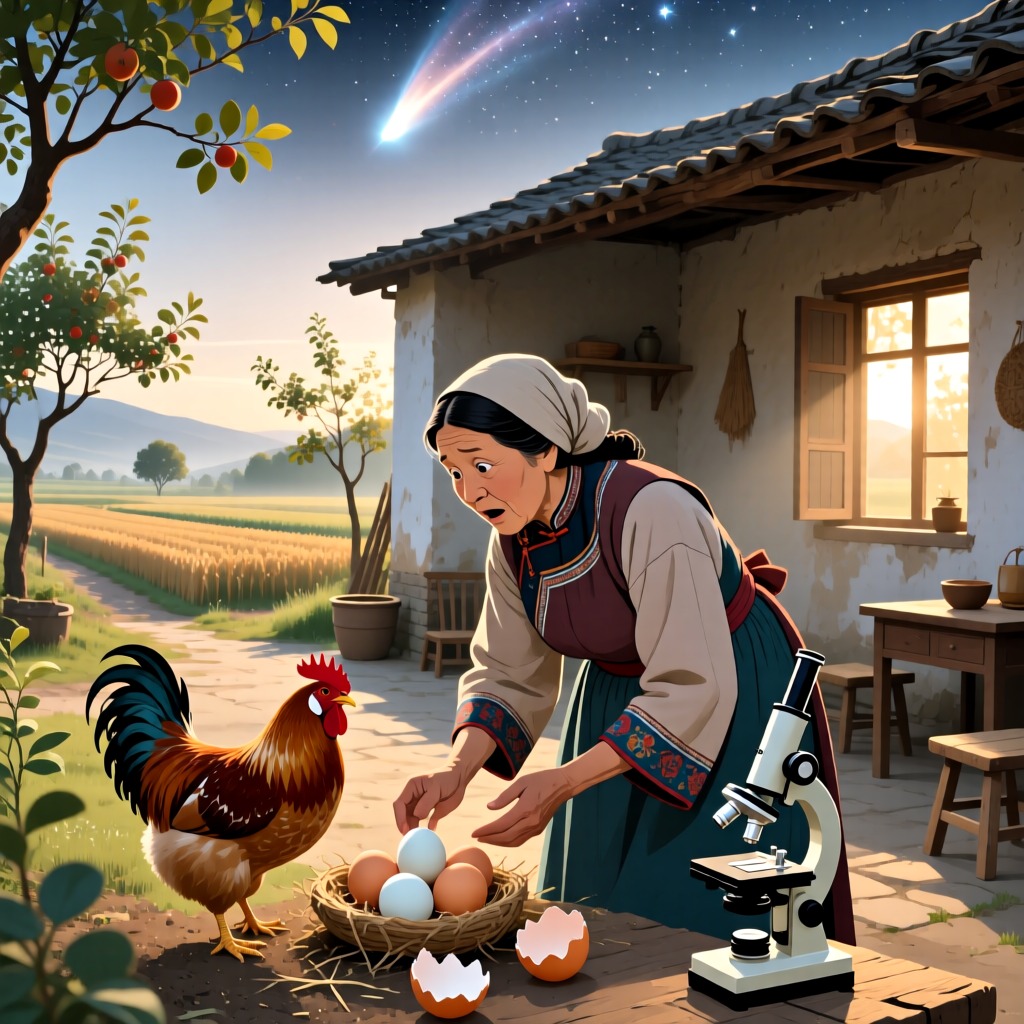
Interestingly, whenever Halley's Comet approaches Earth, strange phenomena tend to occur. In 1682, a hen in Marburg, Germany, laid an unusual egg covered in star-like patterns. In 1758, a farmer near Hoyk, America, reported a similar occurrence with his hen. In 1834, a hen in Kozani, Greece, laid an egg with clear comet patterns. On May 17, 1910, a woman named Aide Bliar in France had a hen that laid an egg with an indelible comet design. In 1986, a resident in Borgo, Italy, received a precious comet egg.
These mysterious comet eggs remain unsolved enigmas and are considered valuable data for comet research, potentially linked to principles of immune system effects and biological evolution.
