
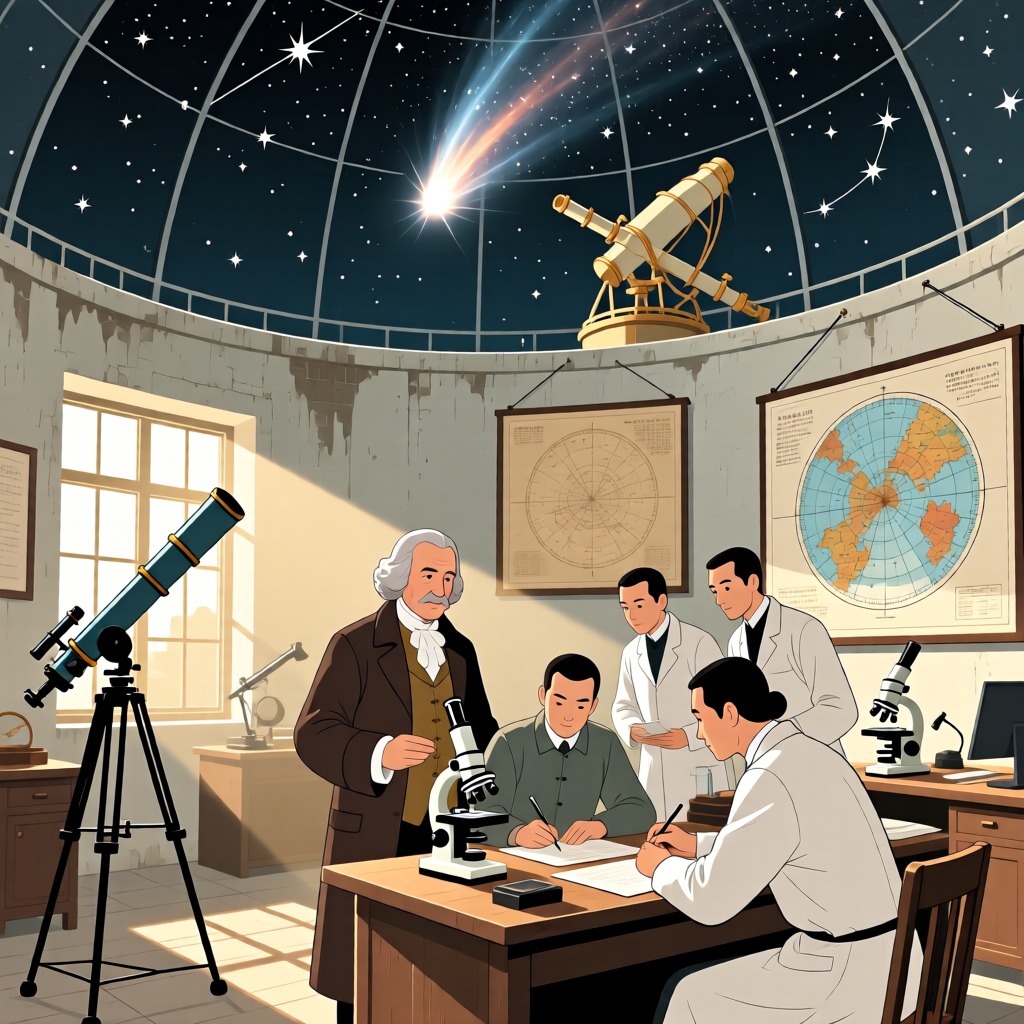

The mystery of comets has captivated humanity for centuries, often seen as ominous signs that incite fear and speculation. In ancient China, they were referred to as "broom stars," believed to herald disasters, famine, and war. However, the appearance of Halley's Comet in 1066 marked a unique historical moment. At that time, Duke William of Normandy was preparing to invade England, and the comet's appearance seemed to signal his impending victory. To commemorate this event, the Duke's wife wove a tapestry depicting the battlefield, with Normandy soldiers joyfully pointing at the comet, while the terrified King Harold of England looked on.
Edmond Halley, however, rejected these superstitions. As the director of the Greenwich Observatory, he successfully predicted the return of Halley's Comet using Newton's theories. In 1705, he proposed that the comet would appear every 76 years, a prediction that was confirmed on Christmas Eve in 1758. Although Halley did not live to see this moment, his scientific spirit and predictive achievement made Halley's Comet the first comet in history to be accurately forecasted. This led to the official naming of Halley's Comet, marking a significant advancement in human astronomy.
In the 20th century, Halley's Comet returned to Earth twice, in 1910 and from 1985 to 1986. In 1910, as the comet's tail swept past Earth, people witnessed an unprecedented spectacle, as if the entire sky was illuminated. For astronomers, it was undoubtedly a scientific feast, as they recorded this historical moment with precision instruments.
