
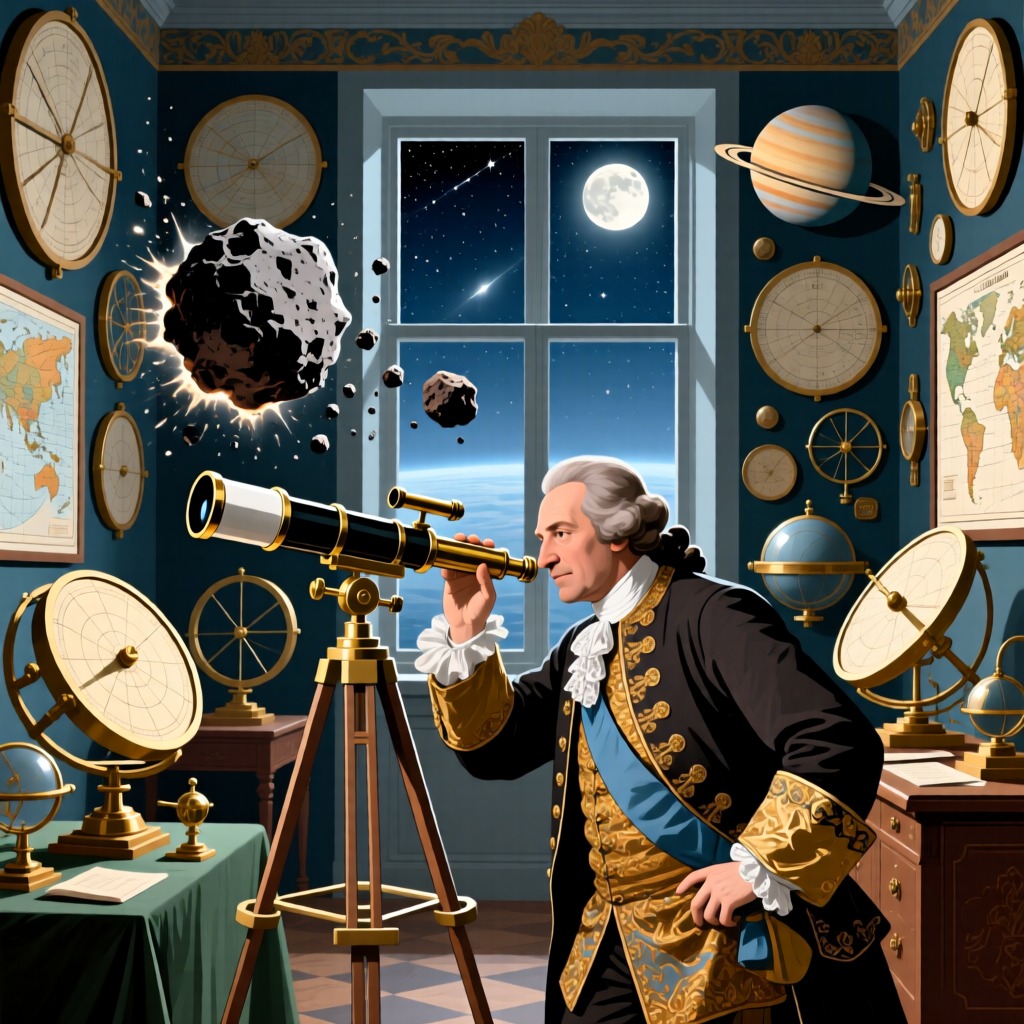

Do asteroids frequently collide with planets?
Scientists have studied the collision issues between asteroids and terrestrial planets. Currently, dozens of Amor, Aten, and Apollo-type asteroids are known to have orbits that fall within the ranges of Mars, Earth, and Venus. Researchers in New Zealand have counted the total number of these asteroids with diameters over 1 kilometer and determined the average probability of collisions with larger planets based on their orbital characteristics. In fact, compared to other planets, Earth has a higher probability of colliding with asteroids, averaging once every 160,000 years; Venus averages once every 300,000 years, Mars once every 1.5 million years, and Mercury once every 5 million years.
Why do so many asteroids still exist today? This is likely because these asteroids often originate from the asteroid belt, where their orbits are perturbed by the gravitational interactions between planets. Inevitably, some aging comet nuclei also enter the family of high-eccentricity (Apollo-type) asteroids. The lifespans of these asteroids vary: Amor-type asteroids have an average lifespan of about 300 million years, Aten-type asteroids have a total lifespan of only 25 million years, while Apollo-type asteroids have a lifespan of about 100 million years. However, both Apollo and Amor-type asteroids may collide with larger planets and also with asteroids located in the asteroid belt between Mars and Jupiter, further shortening their lifespans.