
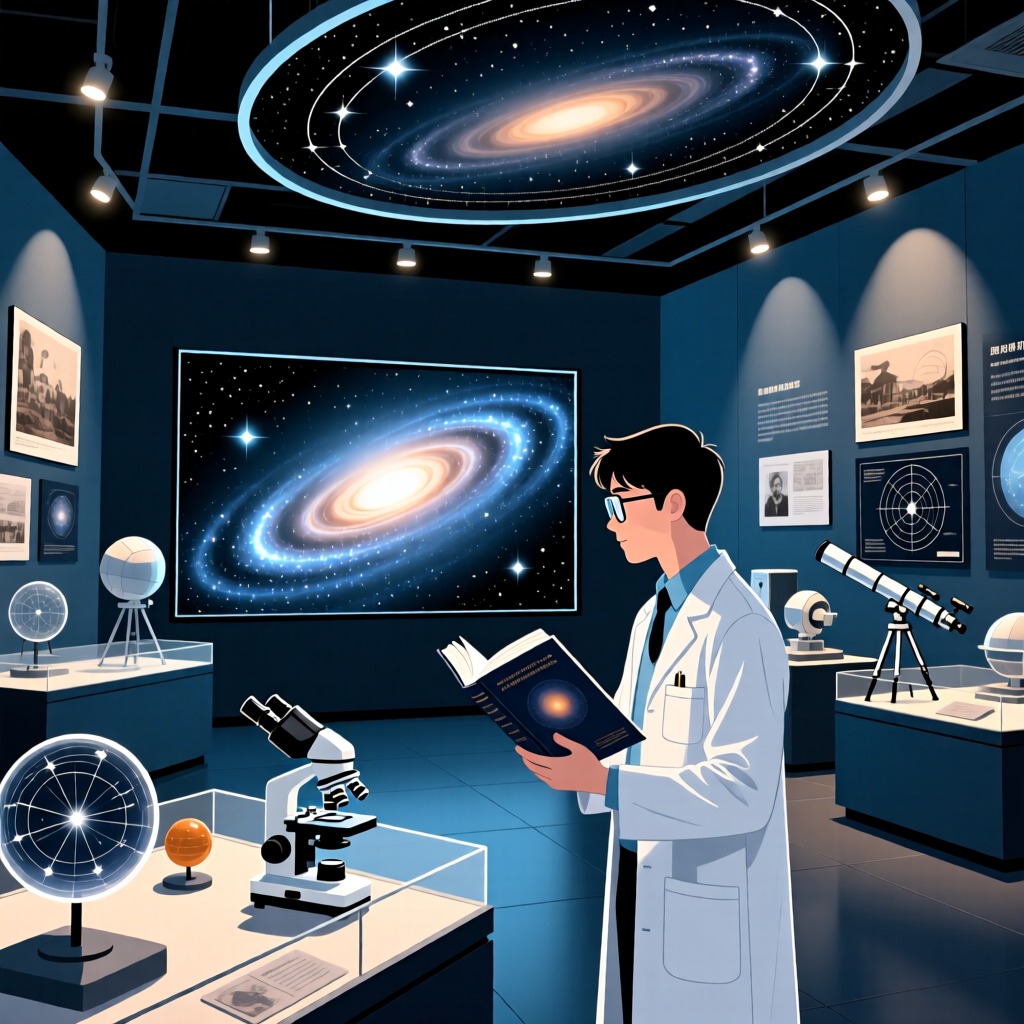

The origin of the universe often leaves people puzzled: Is it eternal and unchanging? How vast is the universe? When and where did it come into existence? How did the matter within the universe form? These questions have sparked countless legends and scientific hypotheses about the origins of the universe.
From the moment humans first gazed at the night sky, there has been a desire to uncover the secrets of the cosmos. Various myths from different cultures and eras have attributed diverse mythological meanings to the birth of the universe, but these are largely based on imagination and fantasy. Despite significant advancements in modern technology, our understanding of the universe's origin remains largely in the realm of hypotheses.
Currently, many scientists lean towards the "Big Bang" theory. This theory posits that about 20 billion years ago, the matter that constitutes the universe we observe today was concentrated in an extremely small point, with an incredibly high density and temperatures exceeding 10 billion degrees Celsius, known as the primordial fireball. At this time, the universe contained no stars or galaxies, only radiation. Subsequently, the primordial fireball underwent a massive explosion, causing matter to scatter, gradually cool, and form the cosmic structures we see today. This process reveals the evolution of the universe from chaos to order.
In 1929, Edwin Hubble discovered, through observations of 24 galaxies, that they were all moving away from us, confirming that the universe is expanding. By calculating the Hubble constant, scientists inferred that the universe is approximately 20 billion years old. Additionally, the existence of cosmic microwave background radiation further supports the Big Bang theory, but it also raises many unanswered questions, such as the state of the universe before the Big Bang and the mechanisms that triggered it.
Another perspective is the "eternal universe" hypothesis, which suggests that the universe has remained in a relatively stable state since its formation. The "hierarchical universe" hypothesis posits that the structure of the universe is multi-layered, evolving from stars to galaxies and then to galaxy clusters, with each level continuously evolving.
Although these hypotheses provide partial explanations, they still require further research and refinement.
