
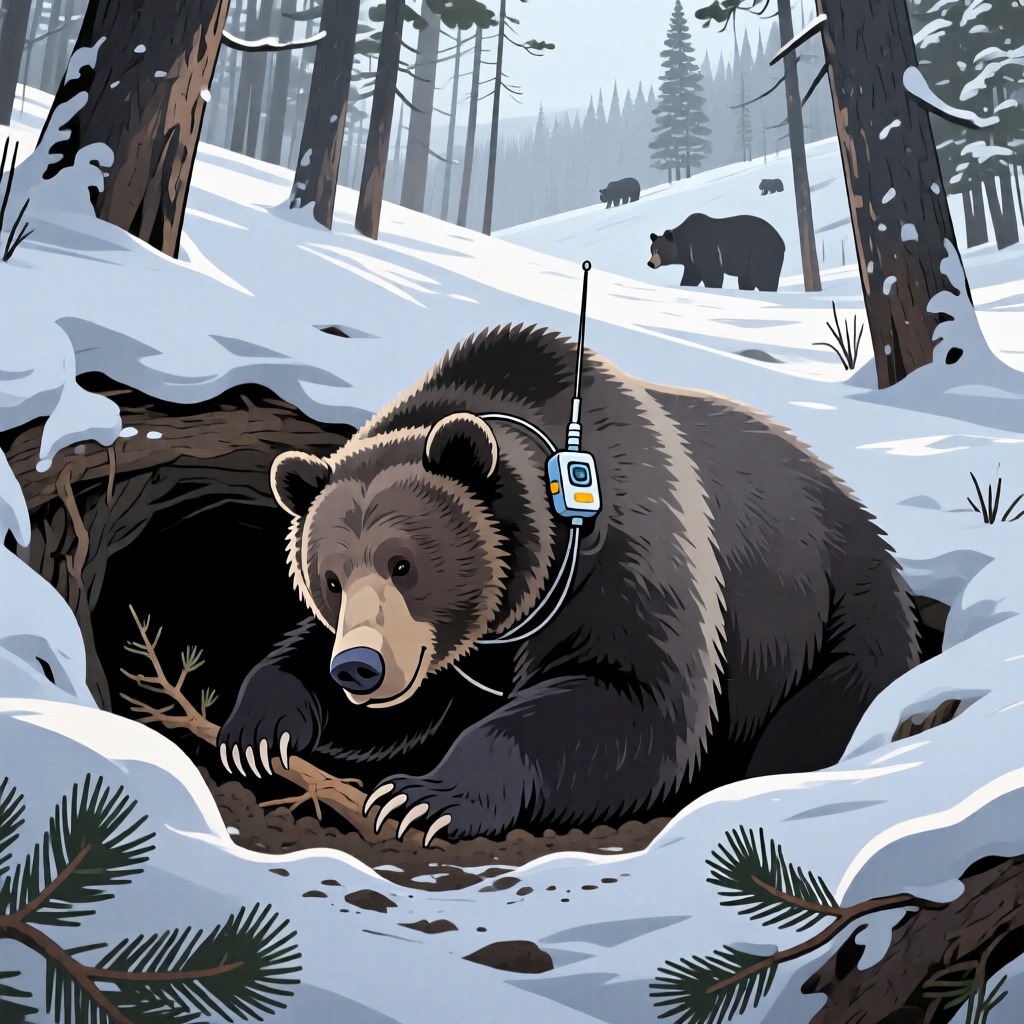

In Yellowstone National Park, a species of wild grizzly bears has captured the interest of scientists. To uncover the secrets of grizzly bear hibernation, a team of biologists, medical experts, and physicists has come to the area. They utilize advanced biotelemetry technology to conduct detailed observations of the bears.
Before winter arrives, grizzly bears dig out their dens and line them with pine branches to prepare for the impending hibernation. As temperatures drop, the bears' metabolism begins to slow down, and they become lethargic, wandering slowly in the fields and yawning. Eventually, the bears retreat deep into the forest to begin their hibernation. Scientists track the bears using radio devices attached to them, recording this entire process.
However, sometimes the bears' behavior can be puzzling. On one occasion, after the first snowfall, a grizzly bear did not immediately enter its den but instead continued to reinforce its shelter. It wasn't until the sun came out, the weather warmed, and the snow melted that the bear decided to hibernate. What secrets lie behind this behavior?
After years of observation, scientists have discovered that grizzly bears seem to possess a mysterious "biological clock." This "clock" can sense the Earth's "pulse," including temperature, air pressure, snowfall amounts, and the availability of food. When temperatures drop, the first signal from the "biological clock" prompts the bears to start preparing for hibernation; the second signal encourages them to wander in the forest; and the third signal indicates it is time for the bears to truly enter hibernation.
How do grizzly bears perceive these changes? How does their "biological clock" operate? These questions remain unsolved mysteries to this day.