
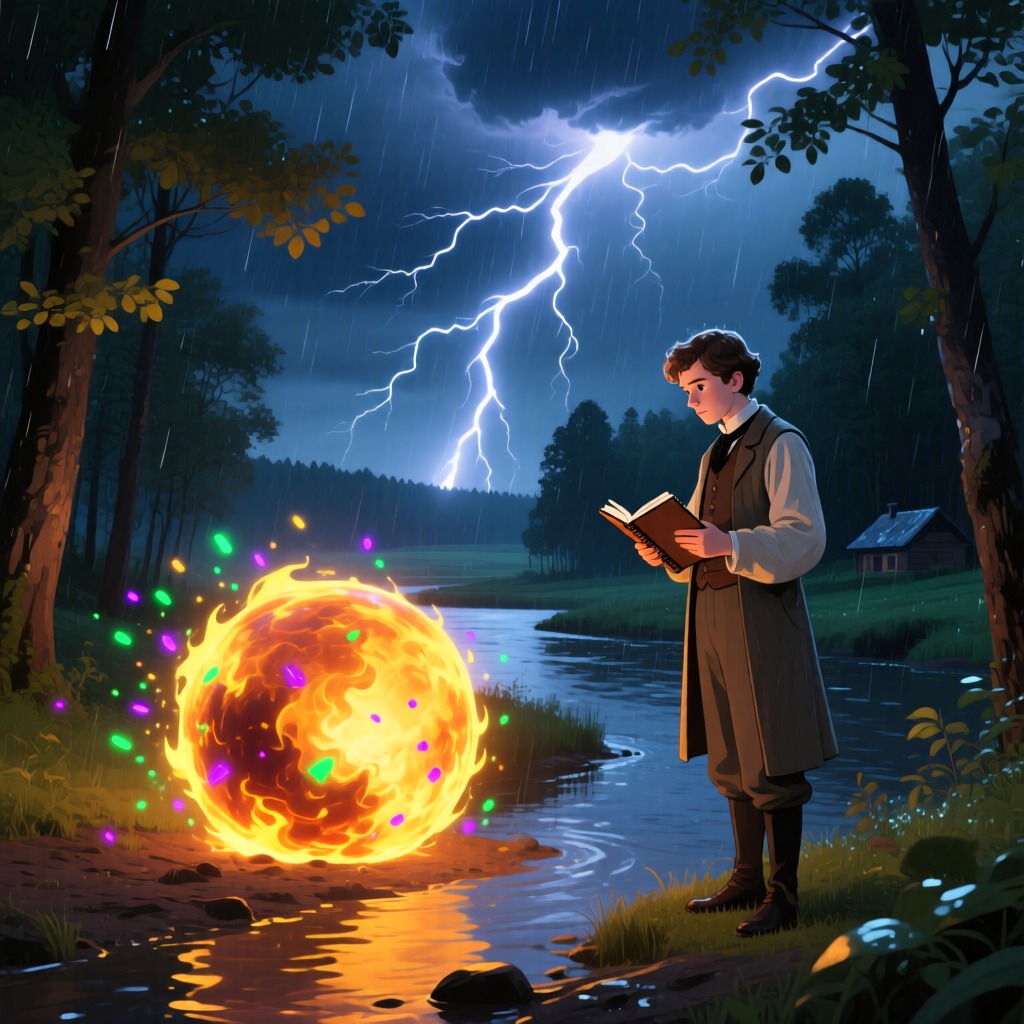

Lightning is a common natural phenomenon, but in certain cases, a peculiar form of lightning appears—ball lightning. Unlike ordinary lightning, ball lightning moves slowly, can last for several seconds, and is often accompanied by a loud bang or can be completely silent. Typically, ball lightning appears in red, yellow, or orange and ranges from 10 to 20 centimeters in diameter, appearing near the ground and even passing through glass into buildings.
Throughout history, there have been many records of ball lightning. In July 1962, a ball lightning event occurred when it passed through a window of a house in Taishan, moving slowly before exploding in the chimney, causing damage only to a thermos. In 1981, an Il-18 aircraft encountered ball lightning during flight, resulting in localized damage to the fuselage, but fortunately, no passengers were harmed. These incidents are not only astonishing but have also sparked scientific interest in the phenomenon of ball lightning.
How is ball lightning formed? It remains a mystery to this day. Some have suggested that ball lightning may originate from the separation at the end of a typical lightning strike, formed by the condensation of plasma; others believe it could be a product of glowing gases in the atmosphere or caused by microwave radiation within the plasma layer. Despite various explanations, there is still no consensus.
In 1956, Soviet scientist Dmitriev witnessed a pale red fireball rolling across the ground while vacationing by the Onega River, providing valuable clues for the study of ball lightning.
