
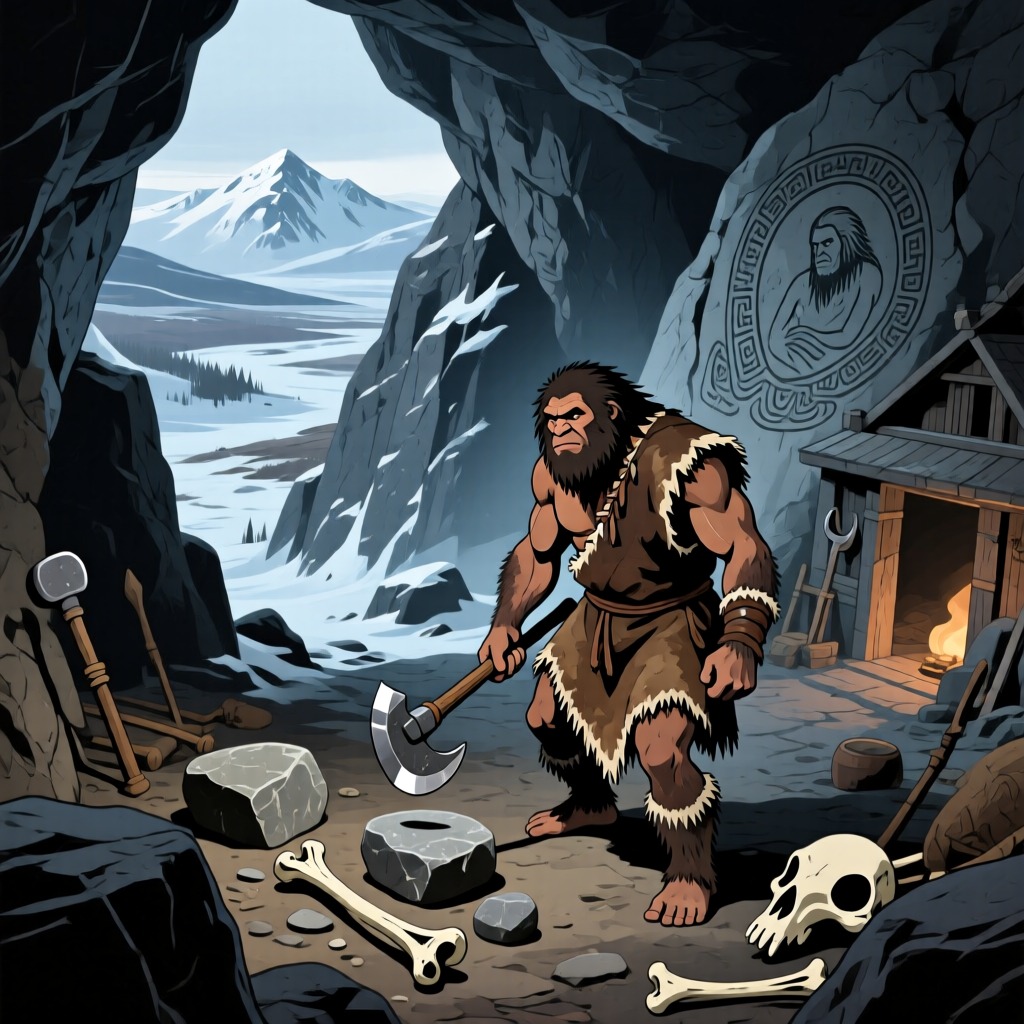

The Neanderthals lived around 100,000 to 200,000 years ago and played a significant role in human history. Their living arrangements were diverse; some resided in caves while others camped outdoors. They skillfully utilized animal migration routes to access abundant meat resources and were adept at bird hunting and fishing. Based on excavated skulls, Neanderthals exhibited physical traits similar to apes, yet their brain capacity was comparable to, or even larger than, that of modern humans. They had robust physiques, resembling contemporary Eskimos. Neanderthals were capable of crafting exquisite stone tools and had mastered the technique of creating fire. They also engaged in large-scale hunting activities, sometimes using terrain advantages to drive hundreds of wild horses into traps. Additionally, Neanderthals demonstrated care for their deceased; for instance, a Neanderthal skeleton found in a cave near Rome was surrounded by stone tools, indicating that they had begun contemplating the meaning of life and the afterlife.
However, approximately 70,000 years ago, Neanderthals suddenly went extinct, which remains an unsolved mystery. Scientists have proposed various theories regarding their disappearance. Some suggest that physiological issues led to difficulties in childbirth, reducing their reproductive capacity and ultimately leading to extinction. Others believe that Neanderthals fell behind Homo sapiens in the struggle for survival and were eventually replaced. There are also viewpoints suggesting that Neanderthals may not have completely vanished but instead interbred with Homo sapiens, their genes merging into the bloodlines of modern humans. Despite these theories, the fate of the Neanderthals remains an open question.
