
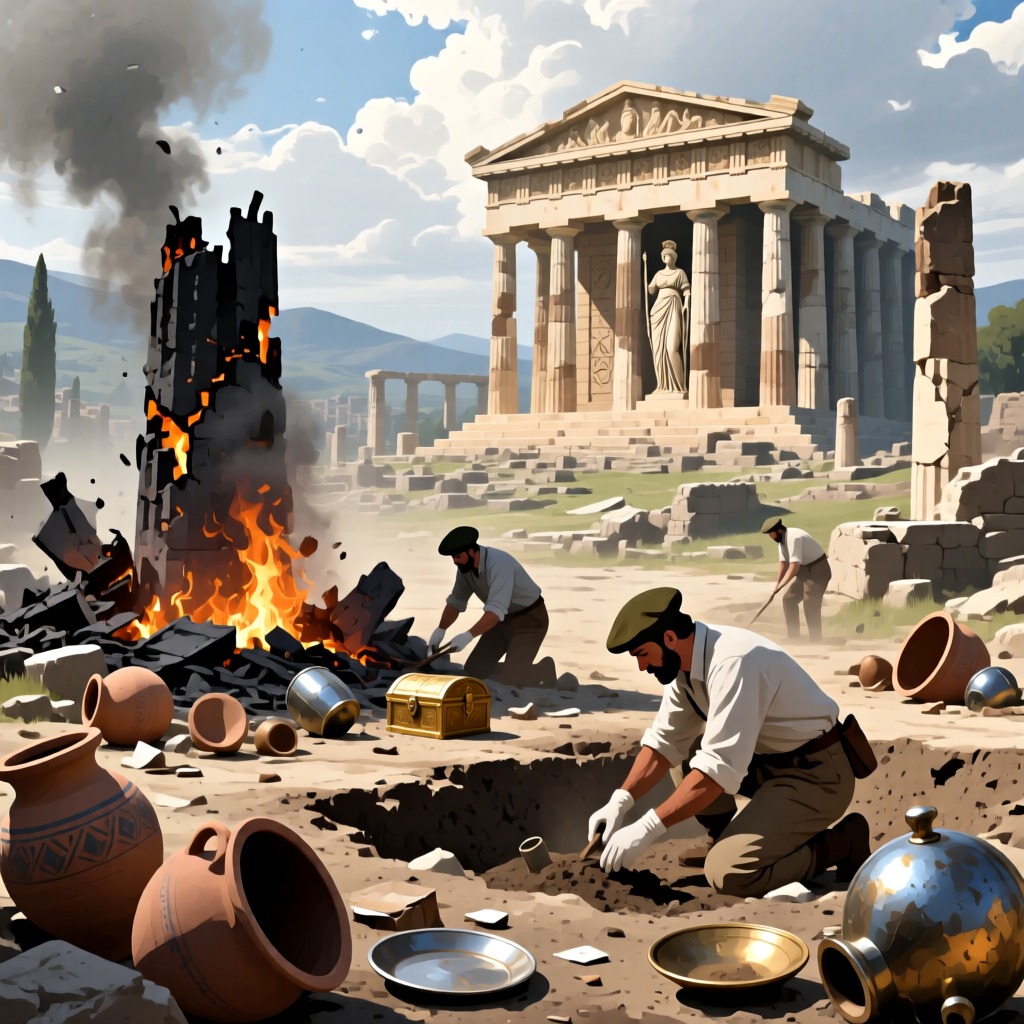

In the mid-19th century, German archaeologist Heinrich Schliemann faced numerous challenges to uncover the ancient city of Troy on Hisarlik Hill in Anatolia, Turkey. There, he discovered a copper vessel filled with thousands of precious artifacts, including gold rings, hairpins, goblets, and vases. Among these treasures, one exquisite gold headdress, made from 16,000 pieces of gold leaf, stands out as a remarkable work of art.
Schliemann's significant discovery garnered global attention. However, the city of Troy met its demise after a decade-long war, leading to much speculation about its historical significance. In 480 BC, Persian King Xerxes held a sacrifice for the goddess Athena at this site. In 330 BC, Alexander the Great visited before his campaign against Persia to seek the goddess's favor. Yet, by the beginning of the Common Era, the area had become desolate; Roman consul Julius Caesar, visiting to honor his ancestors, could only see the ruins. It wasn't until the Roman era that a new city emerged here, only to be destroyed by an earthquake shortly after. Troy gradually faded from collective memory.
Today, through the efforts of archaeologists, the full extent of Troy has been revealed. Excavations have uncovered nine ancient city sites from different historical periods, demonstrating the rich history of Troy's culture. The ruins from around 400 AD showcase the grandeur of the Temple of Athena. Scientific analysis confirms that the ancient city of Troy, dating from 1300 to 900 BC, was completely destroyed by fire, aligning with the accounts in Homer's epics. Although many documents unearthed remain partially deciphered, they continue to unveil the secrets of ancient civilization.