
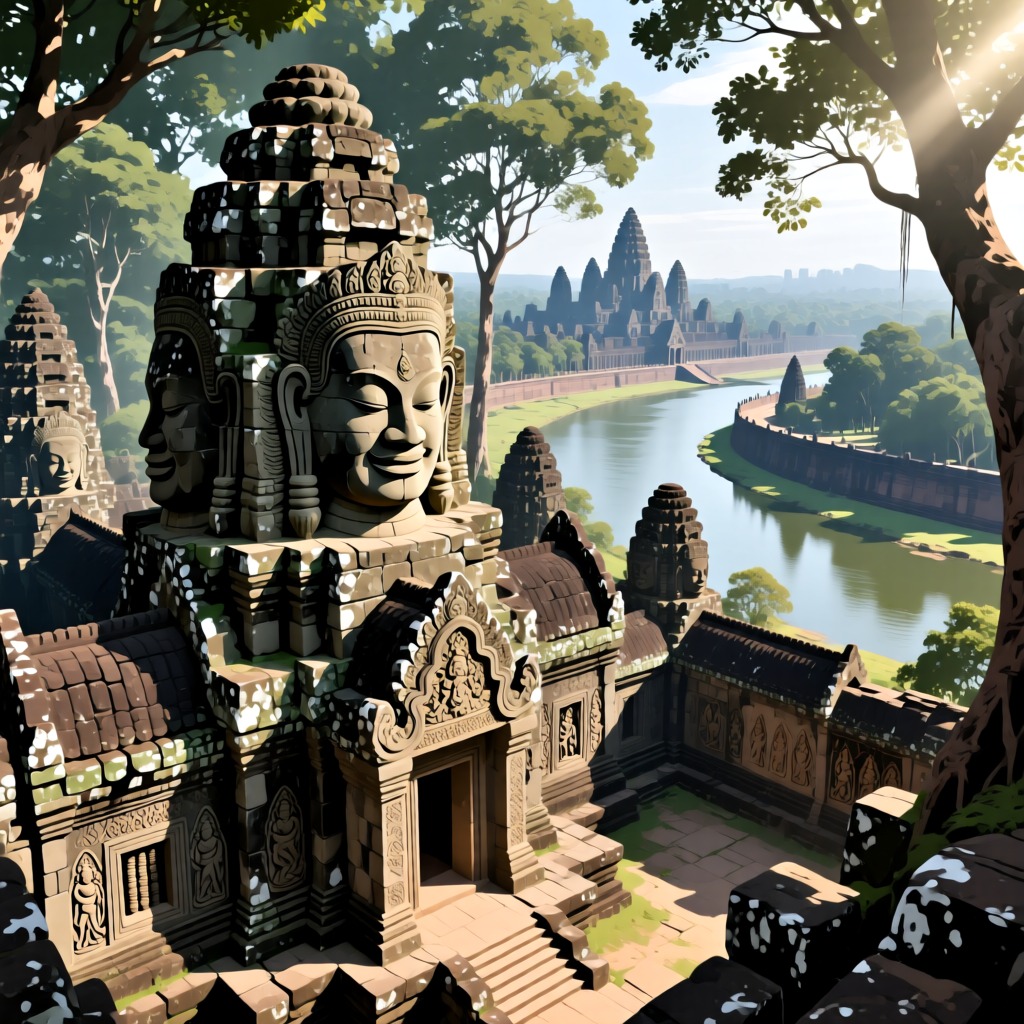

The ancient city of Angkor is a symbol of Cambodia, often referred to as one of the 'Four Great Wonders of the East' alongside the Egyptian pyramids, the Great Wall of China, and Borobudur in Indonesia. In the 12th century, during the peak of the Khmer Empire, King Suryavarman II constructed the famous Angkor Wat to honor the god Vishnu. Angkor is vast, surrounded by a moat, and filled with numerous exquisite towers and temples. Among them, the Bayon Temple stands at the heart of the city, featuring 16 central towers and dozens of smaller towers, creating a unique stepped architectural complex.
People marvel at the intricate bas-reliefs and the clever interlocking of stones used in the construction of Angkor. Remarkably, no adhesives were employed; the stones fit together solely by their weight and shape, which is truly astonishing. However, the reasons for the city's disappearance into the jungle remain a mystery. Some speculate that a plague led to the death of its inhabitants, while others believe that invasions by the Siamese forced the residents to flee. Additionally, the decline of the Khmer Empire may have been linked to internal conflicts.
By the early 15th century, the Khmer Empire was compelled to move its capital to Phnom Penh, and Angkor gradually fell into neglect, becoming overgrown by dense tropical forests. The mysteries surrounding Angkor remain unsolved, leaving endless room for speculation for future generations.