
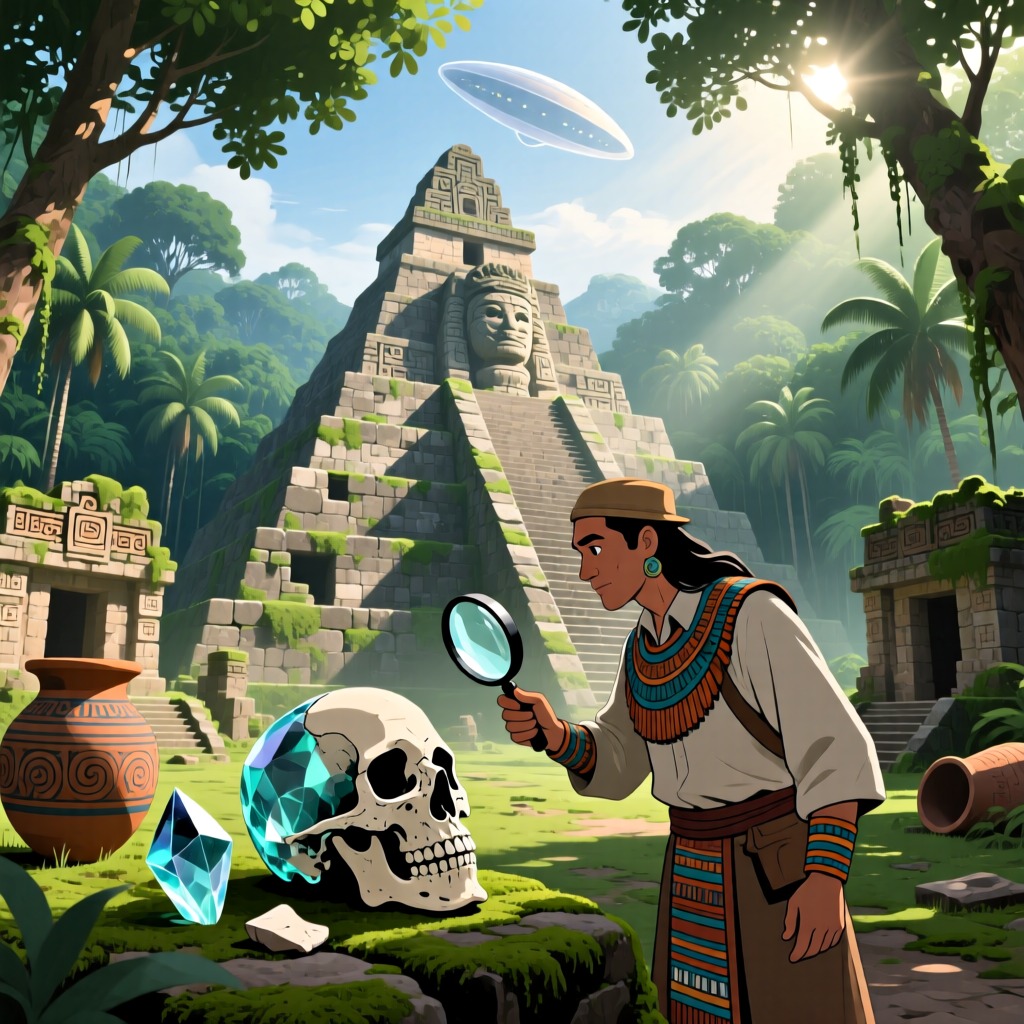

The rise and fall of the Mayan civilization remains one of the greatest mysteries in history. In the 9th century, the Mayan civilization mysteriously vanished, leaving behind countless unanswered questions. One bold hypothesis suggests that the Mayans were not indigenous but rather aliens from a distant planet. This theory was proposed by brothers Erik and Golek, who believe that the Mayan "Tzolk'in calendar" reveals this, as the calendar does not align with earthly timekeeping, implying that the Mayans' homeland is on another planet. The brothers speculate that the Mayans left their planet hundreds of thousands of years ago to mine resources on Earth. They initially settled in the warm Antarctic region but later migrated due to the onset of the Ice Age, eventually establishing themselves in the tropical rainforests of Central America.
The civilization and technology of the Mayans also support this hypothesis. Their city architecture and craftsmanship were far beyond the level of contemporary Earth, even utilizing unknown metals and tools. The pyramids built by the Mayans are enormous and intricate, requiring massive stones to be transported from distant locations, which would have been nearly impossible with the technology of the time. Some suggest that the Mayans, possibly with the assistance of aliens, used flying saucers for transportation, which would explain the absence of roads and transport artifacts. Additionally, the discovery of a crystal skull in Honduras in 1927 adds to the enigma; its high hardness and the presence of a "double crystal" phenomenon indicate an extremely advanced manufacturing process.
These findings have sparked numerous speculations about who the Mayans truly were and why they vanished so suddenly. Interestingly, around 2.5 million people still speak Mayan languages in Central America today, preserving many of their ancestors' cultural practices and customs, suggesting that the Mayan civilization did not completely disappear.