
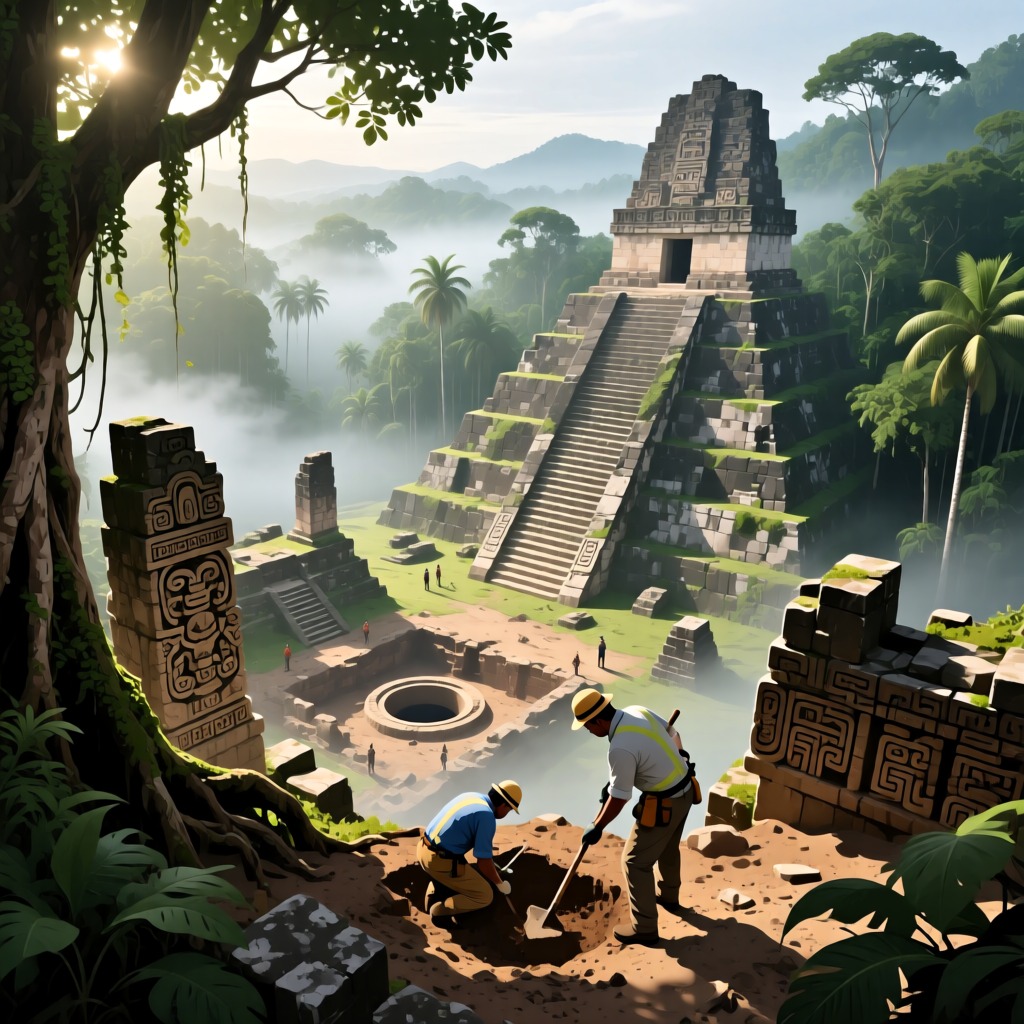

The Maya civilization, which blossomed from humble agricultural and fishing communities around 1000 BC, ultimately fell victim to unknown forces that led to its decline. How did they create such a remarkable culture during the Stone Age? What kind of hardships did they face that caused them to vanish in the tropical rainforests of Central America?
The territory of the Maya spanned Guatemala, Belize, and Mexico, with a significant concentration in the Petén region and northern areas of Guatemala. In 1983, a British painter discovered ruins in the jungles of Honduras, where crumbling walls were adorned with exquisite carvings, and stone roads and drainage systems revealed a once-thriving civilization.
The contrast between the ruins in the jungle and the man-made structures is striking and awe-inspiring. Since the 20th century, archaeologists have been exploring these sites, uncovering Maya pyramids that rival those of Egypt, along with many unsolved mysteries. The Maya constructed nine pyramids, incorporating advanced technology and unknown materials, leading to speculation about possible extraterrestrial connections. However, the development of Maya civilization appears sudden, lacking transitional phases, as if it descended from the sky.
How did these miraculous civilizations come into being? No one knows the answer. Archaeologists and historians are on the hunt for clues, but the enigma remains. The Maya possessed astonishing astronomical knowledge and mathematical skills that seem at odds with their way of life. Is this a pinnacle of human intelligence, or a gift from extraterrestrial beings?
