
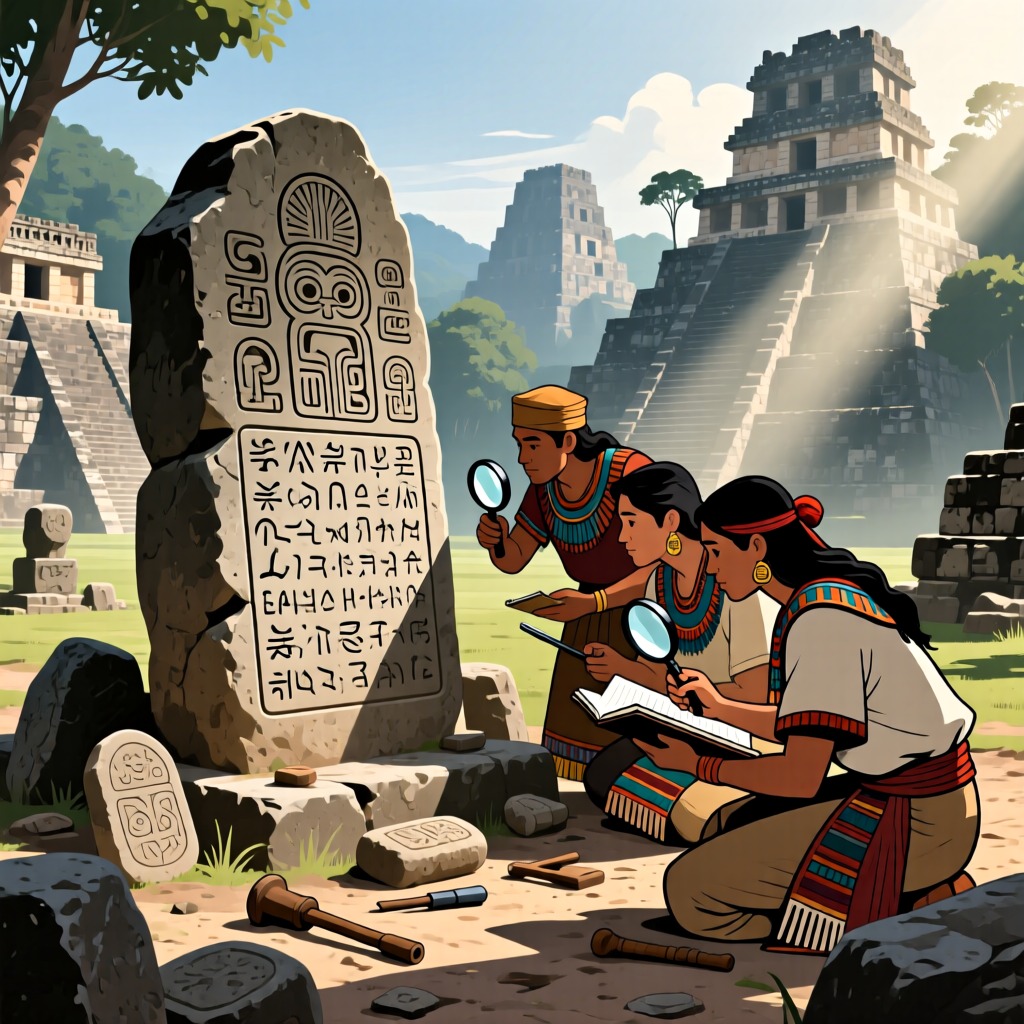

The Mayan script remains one of the great unsolved mysteries in human history. The hieroglyphic staircase at the Copán ruins in western Honduras is a significant site for the study of Mayan writing. This staircase features over 2,500 hieroglyphs, each enclosed in square or circular patterns, depicting figures of people, animals, or abstract designs. These inscriptions once recorded extensive astronomical calendars and prophecies, but due to the destruction by Spanish colonizers, we now rely on three surviving manuscripts for research.
The Spanish colonizers destroyed many Mayan manuscripts, and the three surviving ones are known as the 'Dresden Codex,' the 'Paris Codex,' and the 'Madrid Codex.' Experts believe these manuscripts were actually 'sacred books' written by Mayan priests, documenting various aspects of Mayan civilization. In recent years, scientists have utilized computer-assisted technology to study Mayan script, achieving some preliminary progress. However, fully deciphering these mysterious writings still presents significant challenges.
The journey to decode Mayan script has been long and arduous, attracting countless scholars to its pursuit. Although we cannot yet fully understand all the symbols, ongoing research is gradually unveiling the secrets of Mayan civilization. The Mayan script not only carries the knowledge of an ancient civilization but also serves as a bridge connecting the past with the future.
