
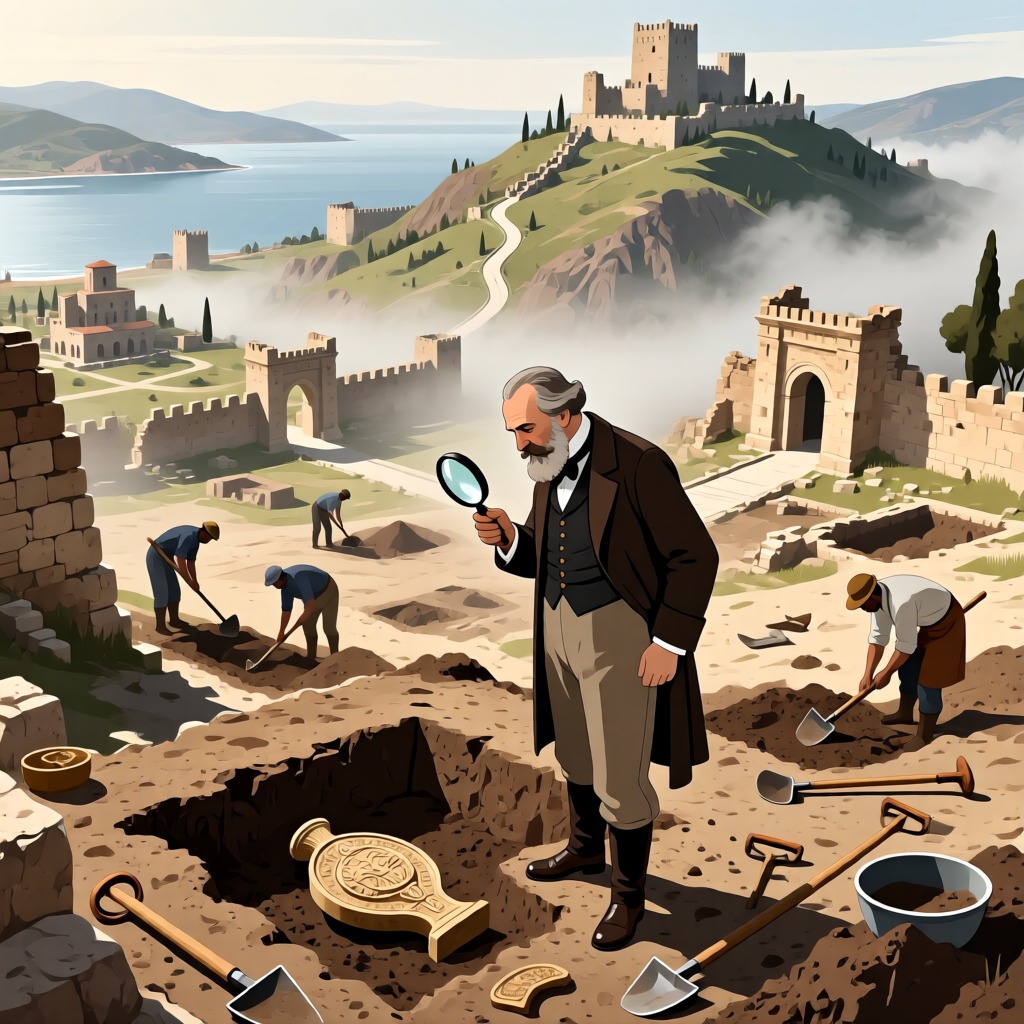

Troy, located beneath the hills of Hisarlik in northwestern Turkey and adjacent to the Dardanelles, has long been a mystery in the hearts of many. For a long time, it was believed to be a fictional city from Homer's epics until the 1870s when archaeologist Heinrich Schliemann, through relentless efforts, finally unveiled its secrets. Schliemann had been fascinated by the stories of the Trojan War since childhood, particularly the depiction of Troy's burning in the Iliad, which ignited his desire for exploration. In 1870, he embarked on the monumental task of finding the city of Troy.
Schliemann led a team that excavated nine layers of city ruins, but which one was the true Troy remains a topic of debate. In the ninth layer, he discovered artifacts he believed to be the "Treasure of Priam," but it was later confirmed that these sites had been over-excavated. After years of effort, Schliemann confirmed the historical existence of Troy, which experienced multiple rises and falls from 3300 BC to 1275 BC. The ruins of Troy are stratified into nine layers, each revealing different historical periods and cultural characteristics, reflecting the evolution of the city.
Today, historians generally agree that there indeed existed a city of Troy. It reached its peak in the 13th to 12th centuries BC, becoming a target for neighboring states. In the 12th century BC, the Greek coalition captured and destroyed Troy. The descriptions in Homer's epics are based on this war. Schliemann's discoveries not only confirmed the existence of Troy but also suggest that literary works may contain elements of real history.
