
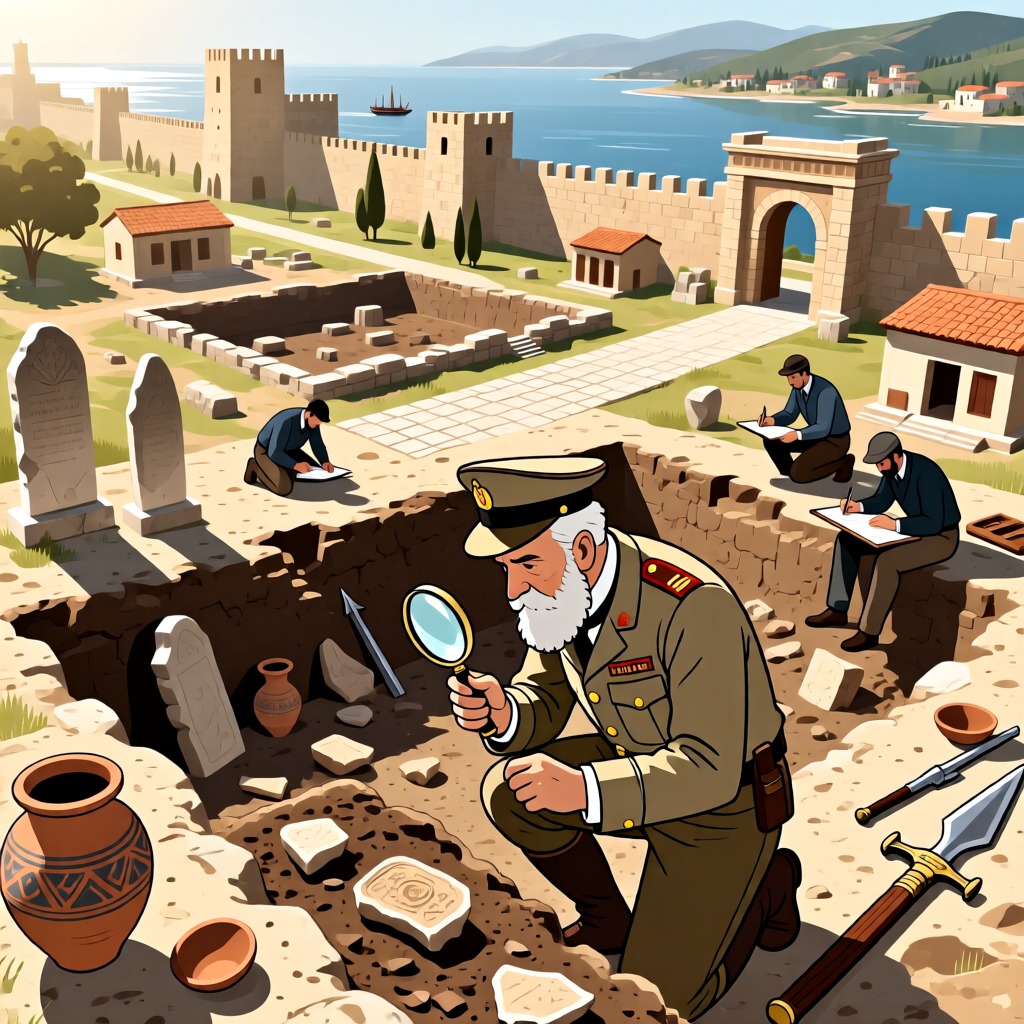

The ancient city of Troy is located beneath the hills of Hisarlik in northwestern Turkey, near the Dardanelles Strait, facing the Balkan Peninsula across the sea. Did the city of Troy described in Homer's epic truly exist? Archaeologist Heinrich Schliemann, driven by his passion for the stories of the Trojan War, confirmed the existence of this ancient city through persistent excavations. Fascinated by the tales, especially the account of Troy's burning in the Iliad, Schliemann's desire for exploration was ignited. After many years, he discovered what he believed to be the site of the 'Treasure of Priam' at the ninth layer, although it turned out to be excavations from a period after the Trojan War.
Troy underwent multiple reconstructions, with a total of nine layers. The first layer dates back to 3300–2500 BC, featuring a stone-built fortress, while the second layer flourished between 2500–2200 BC. The sixth layer reached its peak between 1800–1275 BC, characterized by strong walls extending 540 meters in length. The seventh layer, spanning 1275–1100 BC, is divided into two phases, A and B, with phase A believed to correspond to the Trojan War period. The ninth layer represents the accumulation of Greek civilization, while the tenth layer reflects the cultural deposits of the Roman era.
Today, historians widely agree that the city of Troy indeed existed. It reached its zenith in the 13th to 12th centuries BC, boasting countless treasures. While the stories of the Trojan War and the fall of Troy, as depicted in Homer's epic, are filled with mythological elements, they also reflect the warfare and cultural backdrop of that time.
