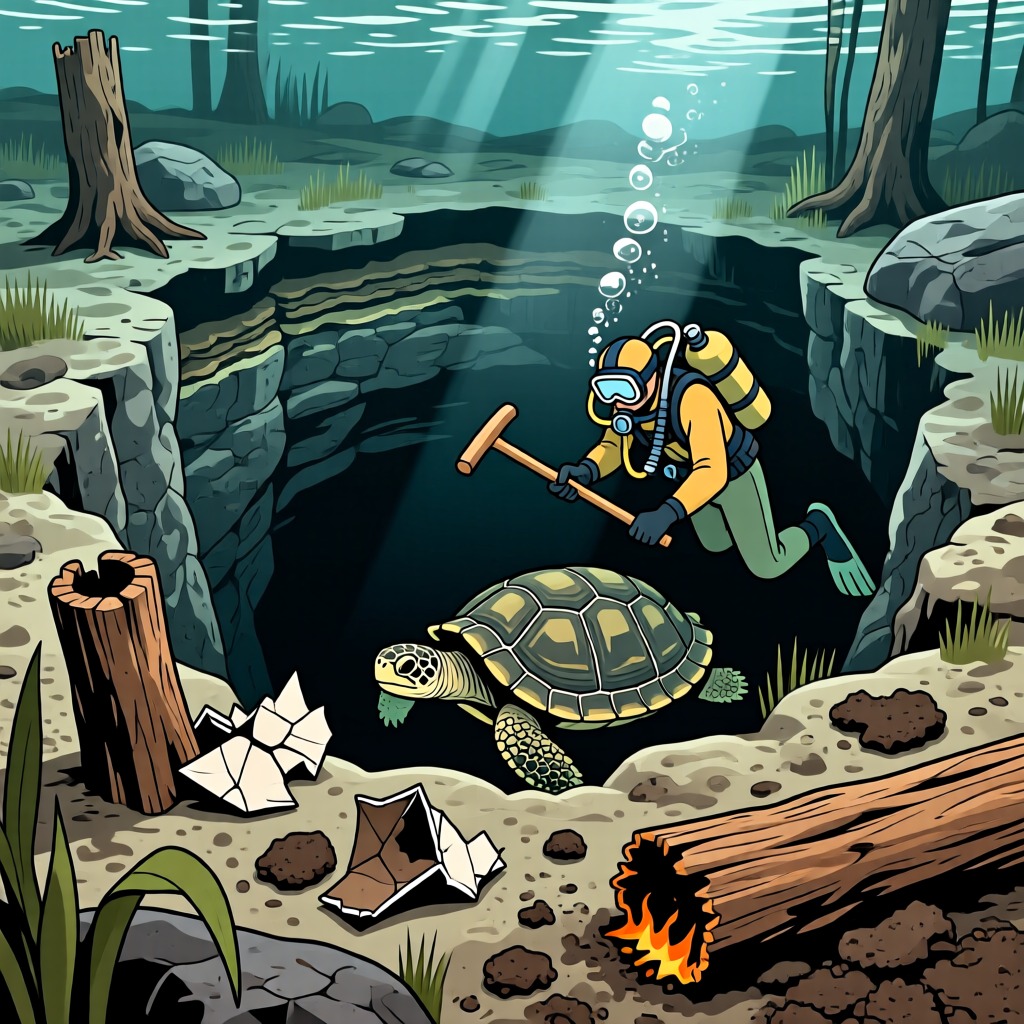
People around the world have heard stories about underwater black holes. Rivers, lakes, and seas often evoke a sense of mystery, as nature conceals many secrets, and the truths of the underwater world are frequently obscured. For instance, Little Spring in Florida is a place filled with enigmas. In 1959, divers discovered a sinkhole at the bottom of the lake, with nearly vertical edges that are astonishing. Scholars speculate that around 12,000 years ago, the water level of this lake was much lower than it is today, and the sinkhole may have served as a source of drinking water and hunting grounds for early humans. Wild animals that came to drink could accidentally fall into the hole, becoming prey. Since 1959, especially in the early 1970s, archaeologists have uncovered sediment layers left by rising and falling water levels over thousands of years, along with well-preserved artifacts from ancient societies on the cave walls. These artifacts include the oldest known atlatl (a spear-throwing tool) and intriguing items such as wooden artifacts and cracked shells of giant turtles. These discoveries reveal hunting methods from the Stone Age, with some suggesting that giant turtles may have gone extinct due to overhunting. Over time, as the groundwater level rose, Little Spring was gradually abandoned until 7,000 years ago when the water level dropped again, allowing people to settle in the area once more. In a nearby swamp, archaeologists also found a burial site from 6,000 years ago belonging to prehistoric Native Americans, one of the largest burial grounds discovered in North America. These findings gradually unveil the mysteries of Little Spring, showcasing the features of ancient civilizations.
Secrets of the Lake: The Ancient Civilization of Little Spring