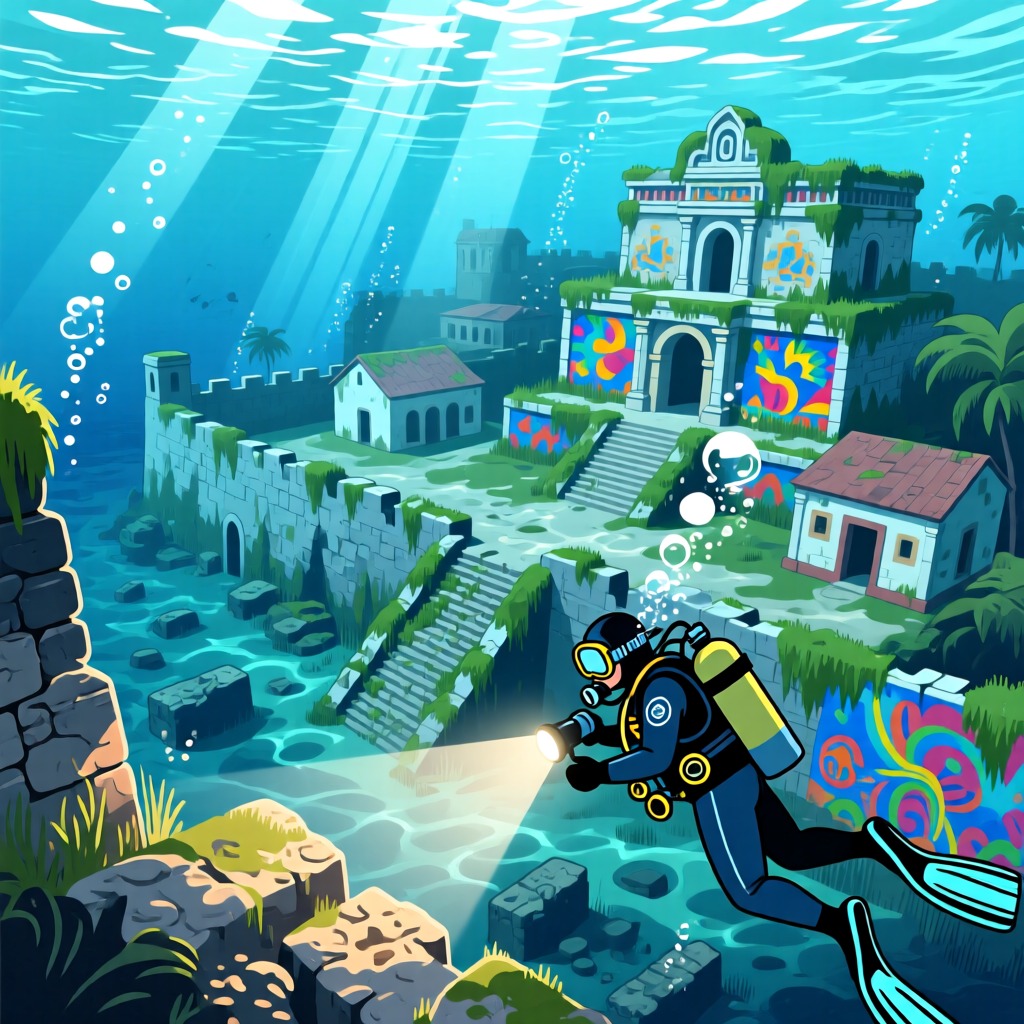
With the advancement of diving and salvage technology, underwater archaeology has emerged. In the tranquil underwater world, many ancient cities that had long disappeared have been discovered. Sunlight sparkles through the water, making these ancient cities seem like they are in a fairy tale. Off the coast of Mexico's Yucatán Peninsula, a group of underwater photography enthusiasts discovered the legendary Mayan city of Tulum. Historical records indicate that this city was once occupied and plundered by Spanish invaders. Underwater archaeologists have found well-preserved city walls, palaces, and residential ruins on the seabed. Similarly, along the coast of Italy, archaeologists have uncovered ruins of houses overgrown with seaweed and marble columns, confirming the existence of the sunken ancient port city of Pyrgi. In the eastern Black Sea, in the Suhumi Bay, archaeologists discovered an ancient city called Dioscurias, built by Milesian immigrants in the 6th century BC, which was an important commercial center. In the eastern Mediterranean, remnants of a submerged city wall can still be seen, believed to be the Phoenician city of Iphdorus. Additionally, off the coast of Dongshan Island in Fujian, China, there lies a Southern Song Dynasty city that sank due to an earthquake. Oceanographers and geologists are fascinated by these sunken ancient cities, exploring the reasons for their submersion, such as earthquakes and land subsidence. The search for these ancient cities has become a contemporary research topic, providing valuable data for history and archaeology.
The Mystery of the Sunken Ancient City