
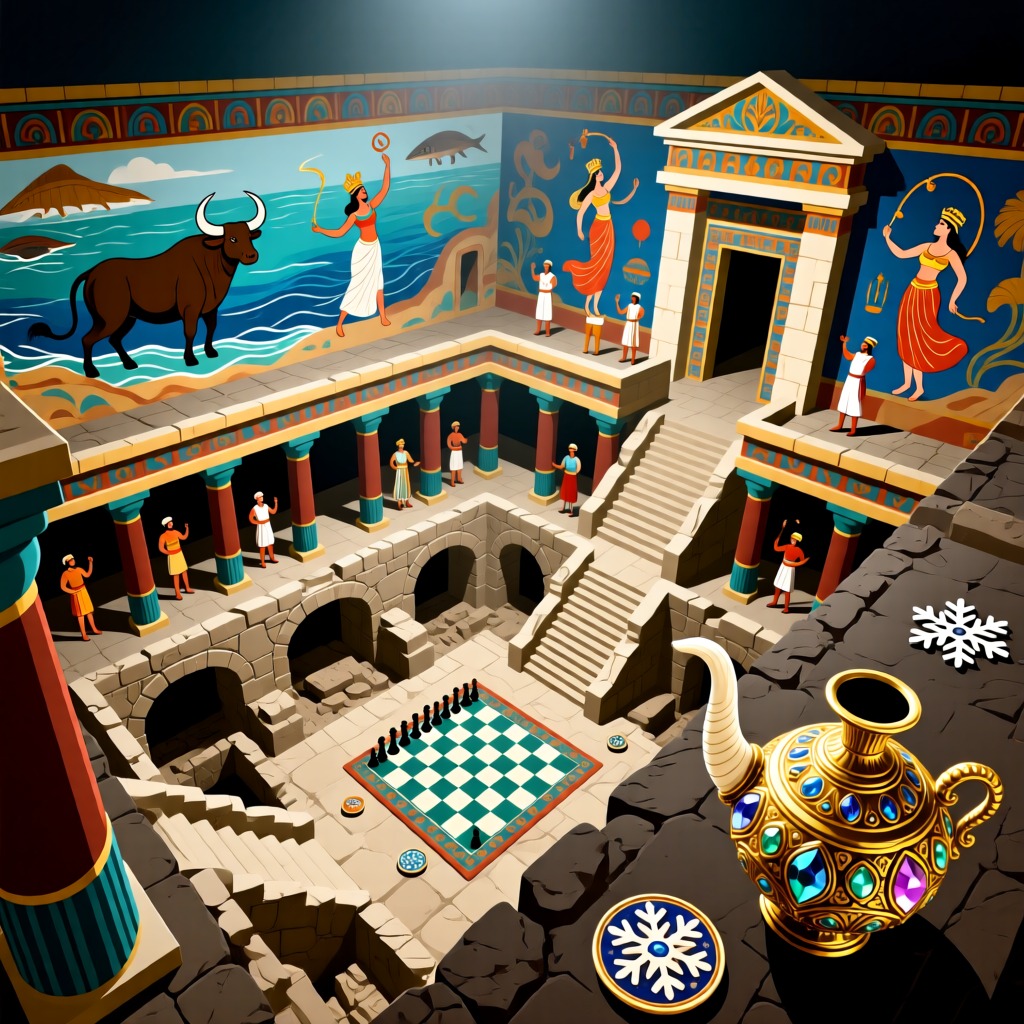

Over three thousand years ago, the Minoan civilization on the island of Crete suddenly vanished, leaving behind a palace site shrouded in mystery. Archaeologist Sir Arthur Evans discovered this palace, which is not only grand in scale but also richly decorated, with murals and artifacts that are truly breathtaking. However, scholars are divided on whether this structure was a palace or a tomb, leading to ongoing debates.
The palace features a complex multi-layered structure, seamlessly integrating underground and above-ground buildings. The murals depict marine life, dancing women, bulls, and acrobats, showcasing the prosperity of Minoan civilization. However, German scholar Wolfgang Wörthlich presents an alternative view, arguing that this was a tomb rather than a palace. He points out that palaces should be located in open areas for defense, while this site lacks water sources and living facilities, making it unsuitable for habitation. Furthermore, no mummies or graves have been found within the palace, only some prehistoric children's bones, which adds to the enigma.
Despite this, the murals and artifacts within the palace still provide significant clues about Minoan civilization, particularly regarding religious rituals that worshipped bulls. These murals may reflect mythological narratives, such as the story of the Minotaur, a creature with the body of a man and the head of a bull, and the Athenian hero Theseus. After 80 years of excavation and research, the true nature of this palace remains largely unresolved.
