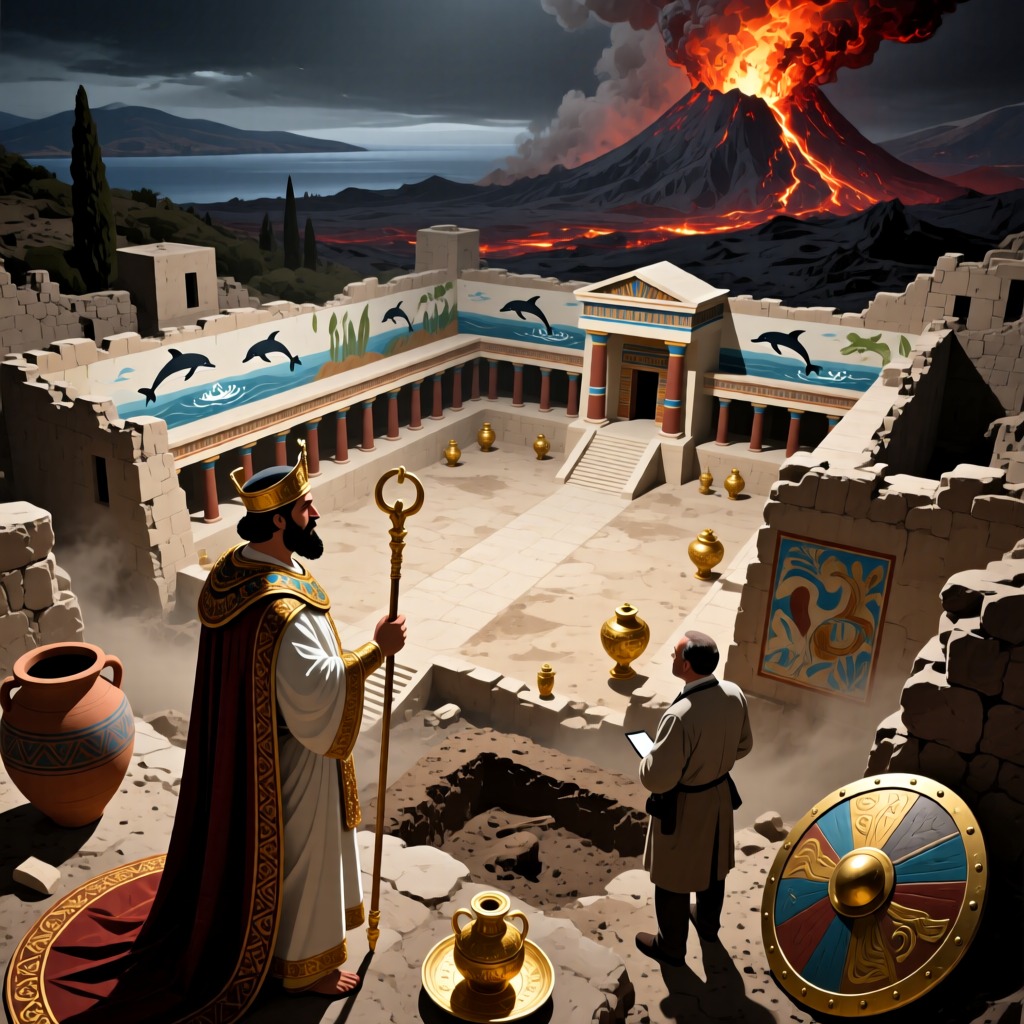
In Greek mythology and legends, King Minos sent his son Androgeus to participate in the games, only for him to be murdered by the King of Athens. Enraged, Minos waged war, forcing Athens to regularly send young boys and girls to Crete, where they were imprisoned in a labyrinth. It wasn't until the 1870s that German archaeologist Heinrich Schliemann discovered the city of Troy, leading British archaeologist Arthur Evans to uncover the significant palace of Minoan civilization on Crete—Knossos Palace. This palace served not only as the political, economic, and cultural center but was also rich in religious significance. The central courtyard of the palace was spacious, surrounded by multi-story buildings, lavishly decorated interiors, and abundant frescoes. However, around 1500 BC, nearly all cities on Crete were destroyed almost simultaneously, and the Knossos Palace was no exception. In 1967, American archaeologists revealed that this destruction might have been caused by a massive eruption of the Santorini volcano, with ash and tsunamis devastating this ancient civilization.
The Mystery of the Destruction of Knossos Palace