
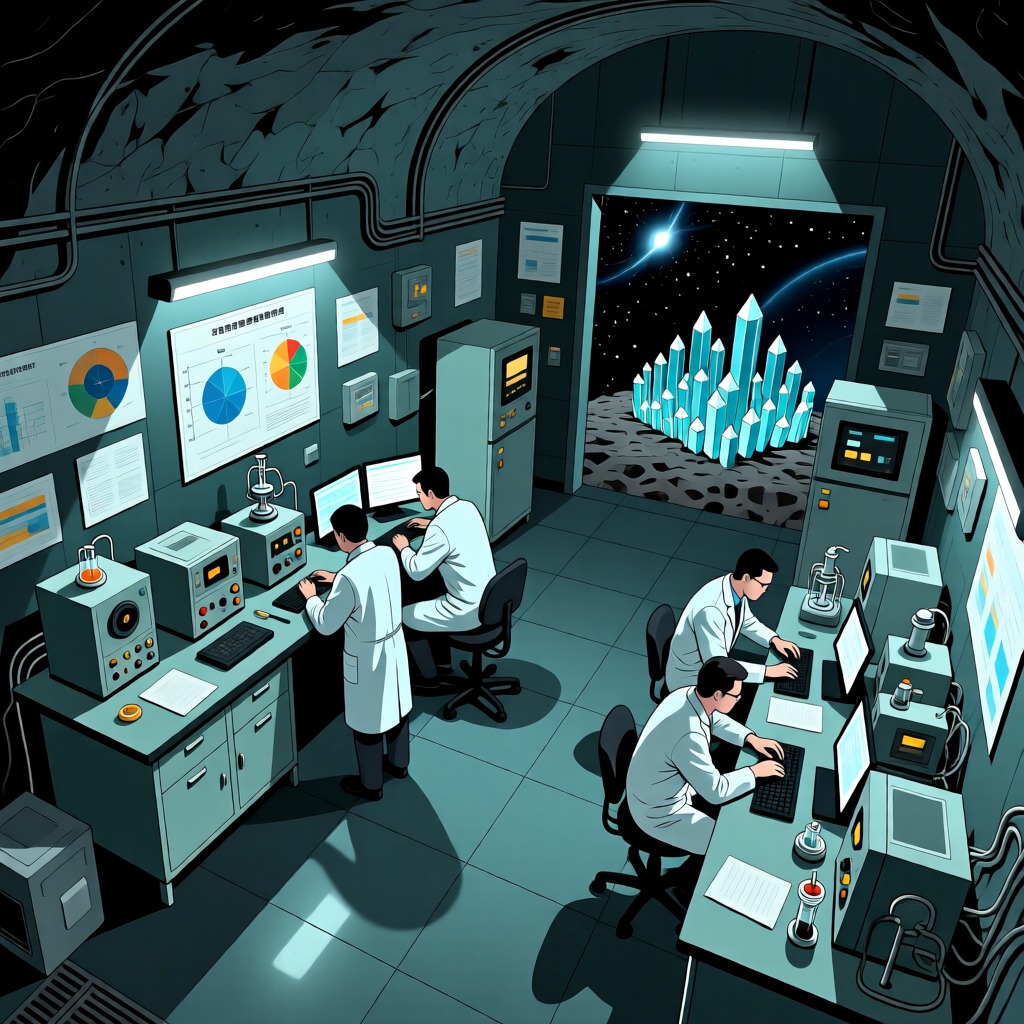

At the dawn of the universe, everything was void. About 15 billion years ago, a tiny point suddenly exploded, bringing the universe into existence. It underwent a long process of expansion and cooling, gradually forming galaxies, Earth, life, and everything we know today. However, behind this seemingly complete story lies a massive enigma: approximately 90% of the universe is composed of invisible dark matter. Scientists, through precise observations and calculations, hypothesize the existence of vast amounts of cold and hot dark matter, yet their true nature remains a mystery.
Researchers are currently working on the "CRESST" weakly interacting massive particle detector at the Gran Sasso National Laboratory in Italy, hoping to capture traces of dark matter. Meanwhile, the Institute of High Energy Physics of the Chinese Academy of Sciences is also actively searching for dark matter, with their research gaining significant attention. In 1972, the Yunnan High Mountain Cosmic Ray Observatory recorded a peculiar phenomenon, which may indicate the existence of a new particle—dark matter. In 1979, scientists discovered an anomaly in the Andromeda Galaxy, suggesting the presence of substantial dark matter within the galaxy. These findings have sparked interest in dark matter, prompting scientists to explore further.
Although various theories have been proposed, such as the axion model and the neutrino model, unraveling the mystery of dark matter still requires more experimental data. Since the 1980s, scientists have attempted to reveal the truth about dark matter through various experimental methods. The DAMA collaboration, which involves the Institute of High Energy Physics of the Chinese Academy of Sciences, has conducted experiments at the Gran Sasso National Laboratory and has detected some potential dark matter signals. These preliminary results provide clues for our understanding of the universe, but more efforts are needed to truly uncover the mystery of dark matter.