
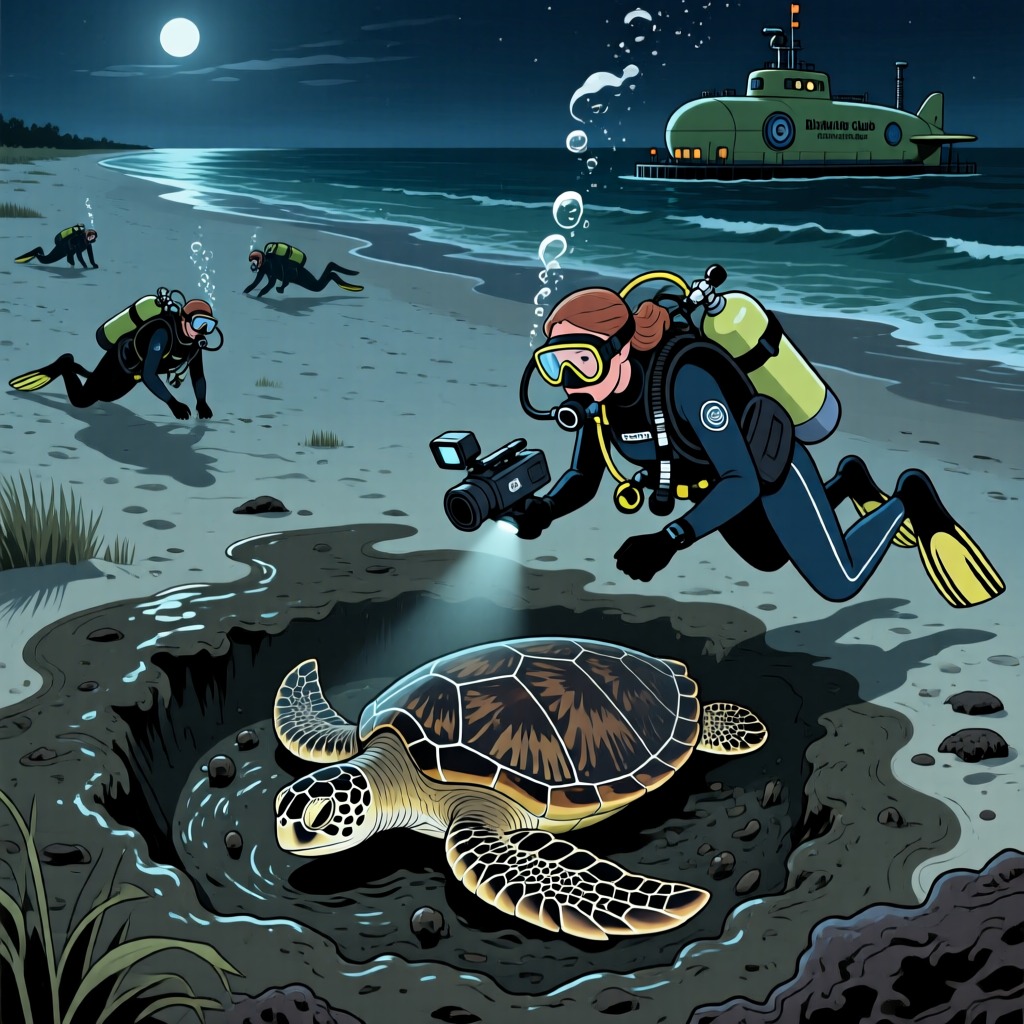

Every year during the breeding season, mother sea turtles stealthily crawl onto the beach at night to lay their eggs, covering them with sand. However, a few years ago, a rare phenomenon was discovered along the east coast of Florida, USA: sea turtles were found burying their entire bodies in the mud. Divers initially mistook them for turtle shells, only to uncover a living sea turtle beneath the mud!
What could be causing sea turtles to bury themselves alive in the mud? Marine biologists have proposed various theories. Some believe it may be a form of hibernation; others suggest it is a method for sea turtles to remove barnacles from their shells; and some think it could be a way for them to warm up in cold seawater.
To uncover the mystery, scientists conducted field observations. They found that many male sea turtles were infested with barnacles, leading them to speculate that the turtles were trying to rid themselves of these parasites by digging into the mud. However, observations showed that when the turtles buried themselves, their heads were submerged in the mud, causing the barnacles on their heads to die from lack of oxygen, while those on other parts of their bodies remained alive. Additionally, some male sea turtles without barnacles also exhibited similar burying behavior, undermining the barnacle removal theory.
Members of a diving club also reported similar sightings during their training. Diver Rose discovered several "turtle shells," which were actually live sea turtles that spent very little time in the mud. Divers recorded that the sea turtles buried themselves at a depth of about 27.4 meters and a water temperature of approximately 21.7°C, indicating that the turtles were not burying themselves for warmth or hibernation.
Despite scientists dismissing various theories, the true reason behind the sea turtles' self-burying behavior remains an unsolved mystery. Is it an occasional behavior or a regular survival strategy? This question continues to perplex scientists.