
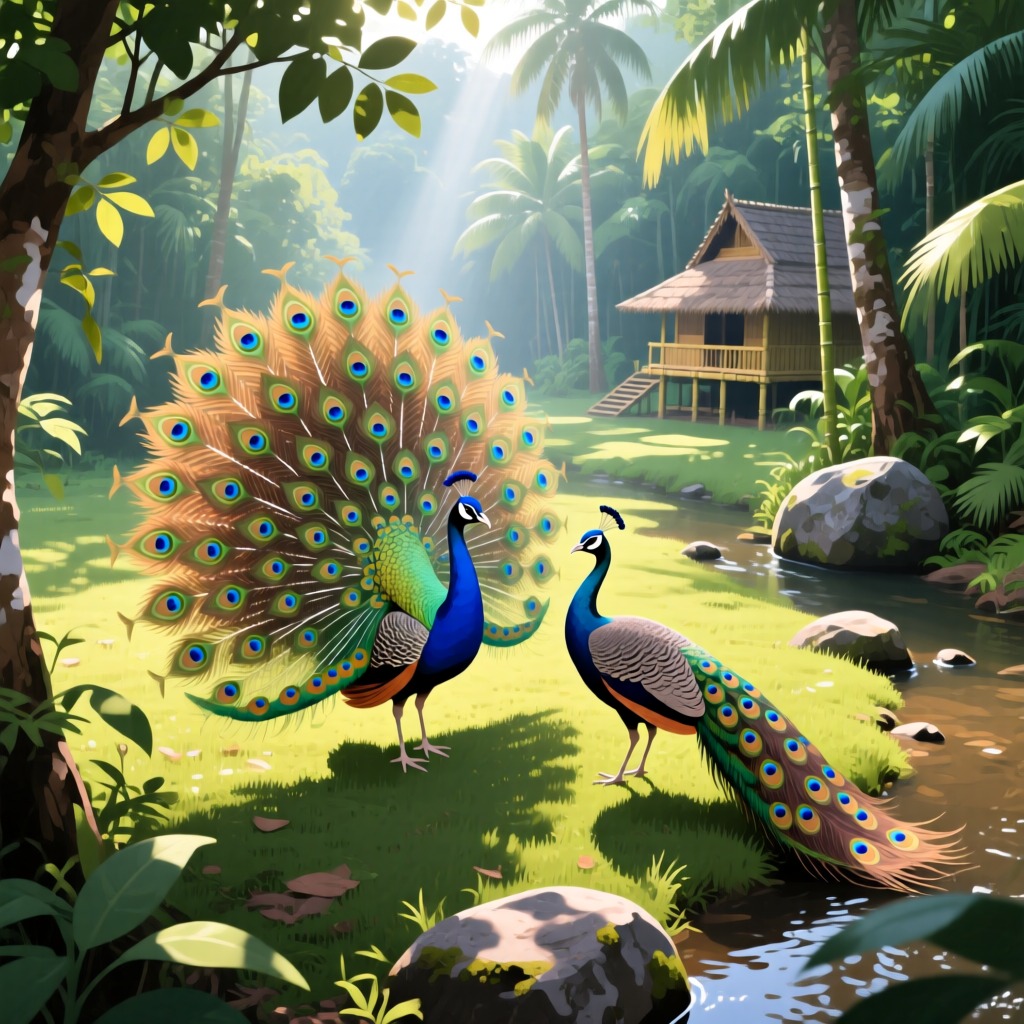

The secrets of peacock feathers
There are two main members of the peacock family: the Chinese peacock and the Indian peacock. The Chinese peacock is found in Yunnan's Xishuangbanna and Southeast Asia, while the Indian peacock inhabits India and Sri Lanka. Although they share some similarities in appearance, the differences between male and female peacocks are striking. Male peacocks boast vibrant plumage that resembles a fan when fully displayed, while female peacocks have dull gray-brown feathers.
In the past, many believed that only the flamboyantly fanned peacocks were the true peacock princes. This is a complete misconception. The differences in appearance between males and females are significant; male peacocks are visually stunning, while females are modest and understated, akin to Cinderella. Male peacocks not only exhibit a rich array of colors but also possess long tail feathers adorned with iridescent blue eye spots, resembling 'angel feathers.'
When male peacocks fan their feathers, it resembles a massive, shimmering fan that captures the attention of onlookers. The peak season for peacock displays occurs in April and May, coinciding with their breeding period. During this time, male peacocks spread their magnificent plumage and dance behind the female peacocks in an elaborate courtship display. Zoologists believe this behavior is driven by natural instincts influenced by sex hormones. However, some scholars suggest that peacock displays may also serve as a defensive mechanism to confuse and deter potential predators. By showcasing their unique feather patterns, male peacocks warn predators to stay away.
Currently, both viewpoints are still debated, and the exact reasons behind peacock displays remain inconclusive.
