
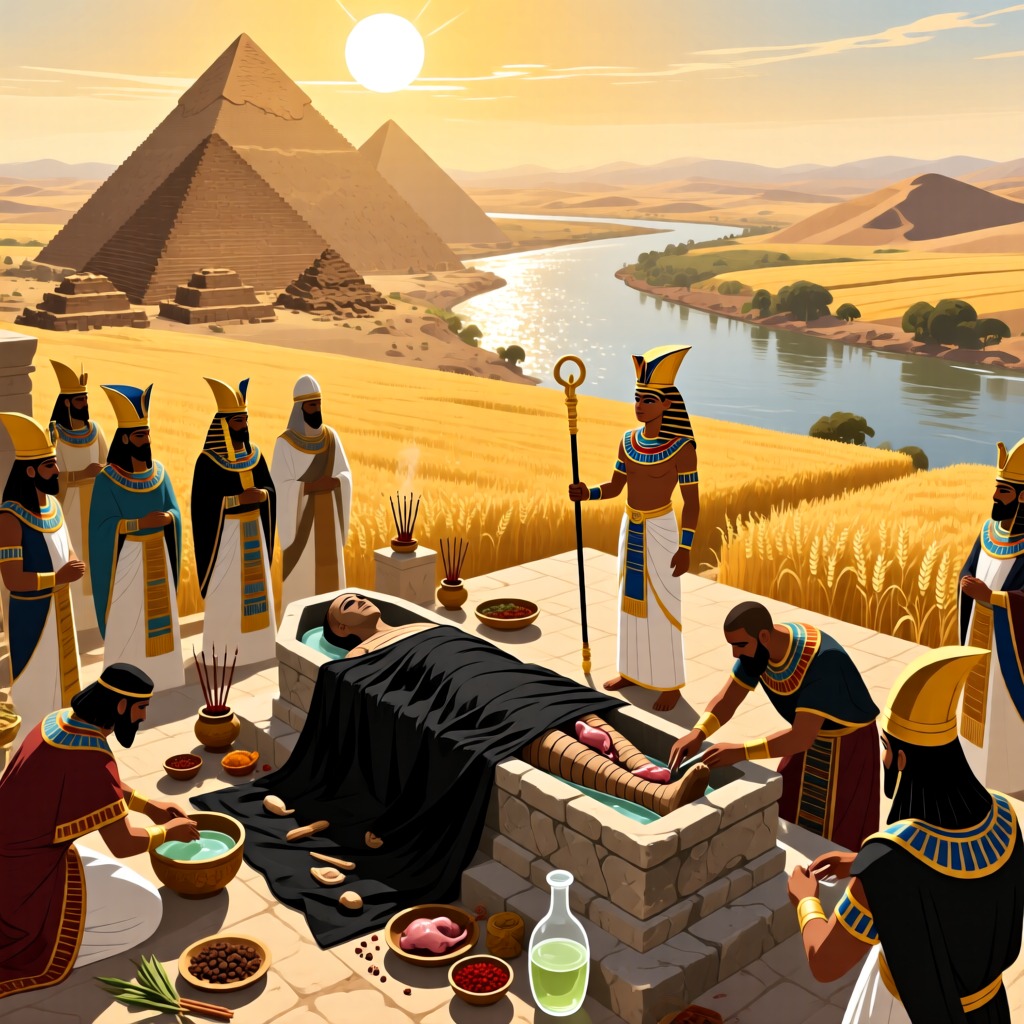

According to legend, in ancient Egypt, there was an extraordinary pharaoh named Osiris. He taught people skills such as farming, baking, digging wells, brewing, and mining, significantly improving their quality of life, and earning their deep respect. However, Osiris's brother, Set, was extremely jealous and conspired to kill him to seize the throne.
One day, Set invited Osiris to a feast, accompanied by many guests. During the meal, Set pointed to a beautiful large chest and said, "Whoever can lie inside this chest will receive it as a gift." Encouraged by the others, Osiris lay down in the chest, unaware that Set would immediately close it, lock it, and throw it into the Nile River. After Osiris was killed, his wife searched tirelessly and eventually recovered his body. Set, upon learning of this, stole Osiris's corpse, dismembered it into 14 pieces, and scattered them across various locations. Osiris's wife managed to find the fragments and secretly buried them.
Later, Osiris's son grew up, defeated Set, avenged his father, and collected the pieces of his father’s body from different places, reassembling them into what we now recognize as a mummy. Osiris's tragic fate moved the gods, and with their help, he was resurrected. However, although he returned to life, he could not return to the human world; instead, he became the ruler of the underworld, judging and punishing the wicked while protecting the good.
This legend primarily conveys the theme of rewarding good and punishing evil, serving merely as a myth. However, the practice of mummification has been a historical reality in Egypt since ancient times. Research indicates that inspired by this myth, every pharaoh would reenact the story of Osiris after death, beginning with a body-finding ceremony, followed by a purification ritual. This involved dissecting the deceased, removing the internal organs and brain, immersing them in a preservative solution to eliminate fat, and soaking off the skin. After 70 days, the body would be taken out to dry, filled with various spices, coated with resin to prevent air contact, and then wrapped in layers of cloth to create a long-lasting mummy. Before the body was placed, a mysterious and solemn incantation ceremony would be held to open the mummy's eyes and mouth, and food would be placed in its mouth, allowing it to supposedly breathe, speak, and eat like a living person. Finally, a burial ceremony would ensue, placing the mummy in a sarcophagus and sending it to its eternal resting place—the pyramid.
Such treatment of the body may seem excessively cruel. If it were not believed that this could prevent decay and allow the gods to resurrect the deceased's soul and body, the ancient Egyptians would never have engaged in such actions. Cryogenic freezing can preserve life and temporarily induce a state of dormancy, where cellular tissues not only have the potential to replicate life but can also continuously generate it. The advancements in technology are indeed astonishing; in the early 20th century, cryogenic freezing was merely a fantasy, but today it is widely used in various fields such as sperm freezing, blood preservation, and organ transplantation. Additionally, cell culture technology has been successfully applied in agriculture and animal husbandry, bringing significant material benefits to human society, while experiments in paleobiology and human anatomy are increasingly approaching breakthrough boundaries.