
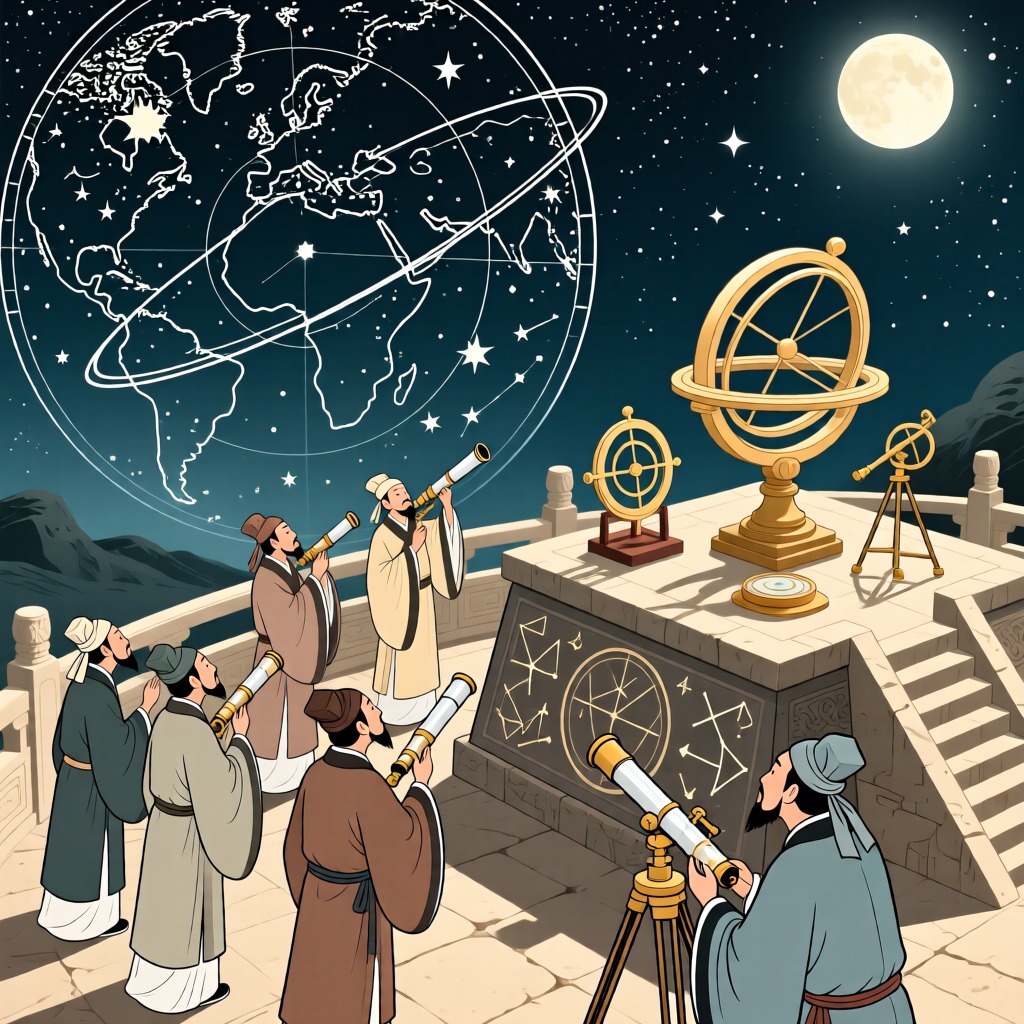

In ancient times, people believed that the Earth was flat, and that the sun sank below the horizon, causing darkness. Others thought that the Earth was stationary, with the sun embedded in the celestial dome, which rotated to create the illusion of the sun rising in the east and setting in the west. Today, we understand that the cycle of day and night we experience every 24 hours is due to the Earth's rotation. While it spins on its axis, the Earth also orbits the sun in an elliptical path, resulting in the alternation of day and night and the changing of seasons, which allows life to thrive. But what forces drive the Earth to move ceaselessly?
Astronomers believe that the solar system formed from an ancient primordial nebula. This nebula was a vast, thin cloud of gas that, influenced by some disturbance and under the force of gravity, began to collapse towards its center. Over a long period of evolution, the temperature and density of the central mass increased until it reached a point where nuclear fusion could occur, leading to the formation of the sun. The residual gas around the sun slowly formed a rotating disk of gas, which, through complex processes of contraction and collision, coalesced into solid particles, planetesimals, and protoplanets, ultimately forming a complete solar system.
We know that to measure the speed of an object's linear motion, we use velocity. But how do we measure the state of an object's rotation? One method is to use "angular momentum." The angular momentum of an object rotating around a fixed point is calculated by multiplying its mass by its velocity and then by the distance from the object to the fixed point. A crucial principle in physics is the conservation of angular momentum, which states that as long as no external forces act on a rotating object, its angular momentum will remain unchanged despite any changes in shape. For example, when a ballet dancer spins and suddenly pulls in their arms (reducing the distance from their center of mass to the fixed point), their rotation speed naturally increases to maintain constant angular momentum. This principle plays a significant role in the generation of the Earth's rotation speed.
The Earth's rotation speed is not constant. Scientists have discovered that it changes over time. For instance, during the Late Ordovician period, about 440 million years ago, it took the Earth 412 days to complete one revolution around the sun. By the Middle Silurian period, 420 million years ago, a year had only 400 days; during the Middle Devonian period, 370 million years ago, it was 398 days; and in the Late Carboniferous period, 100 million years ago, a year was about 385 days. Today, we have 365.25 days in a year. Scientists believe this phenomenon is due to the tidal effects of the moon and the sun on the Earth. On Earth, the ocean surfaces facing the moon and the opposite side experience tidal forces, which slow down the Earth's rotation.
Moreover, the Earth's revolution is not uniform either. The Earth's orbital path is elliptical, with a distance difference of about 5 million kilometers between its farthest and closest points. As the Earth moves from aphelion to perihelion, its proximity to the sun increases the gravitational pull, causing it to speed up. Conversely, when moving from perihelion to aphelion, the Earth's speed decreases.
Thus, it is clear that the Earth's rotation and revolution involve many complex factors, not merely simple linear or angular motion. The Earth also moves with the solar system around the Milky Way and rushes through the universe alongside it. The Earth's ceaseless motion in the cosmos may have begun at the moment of its formation.