
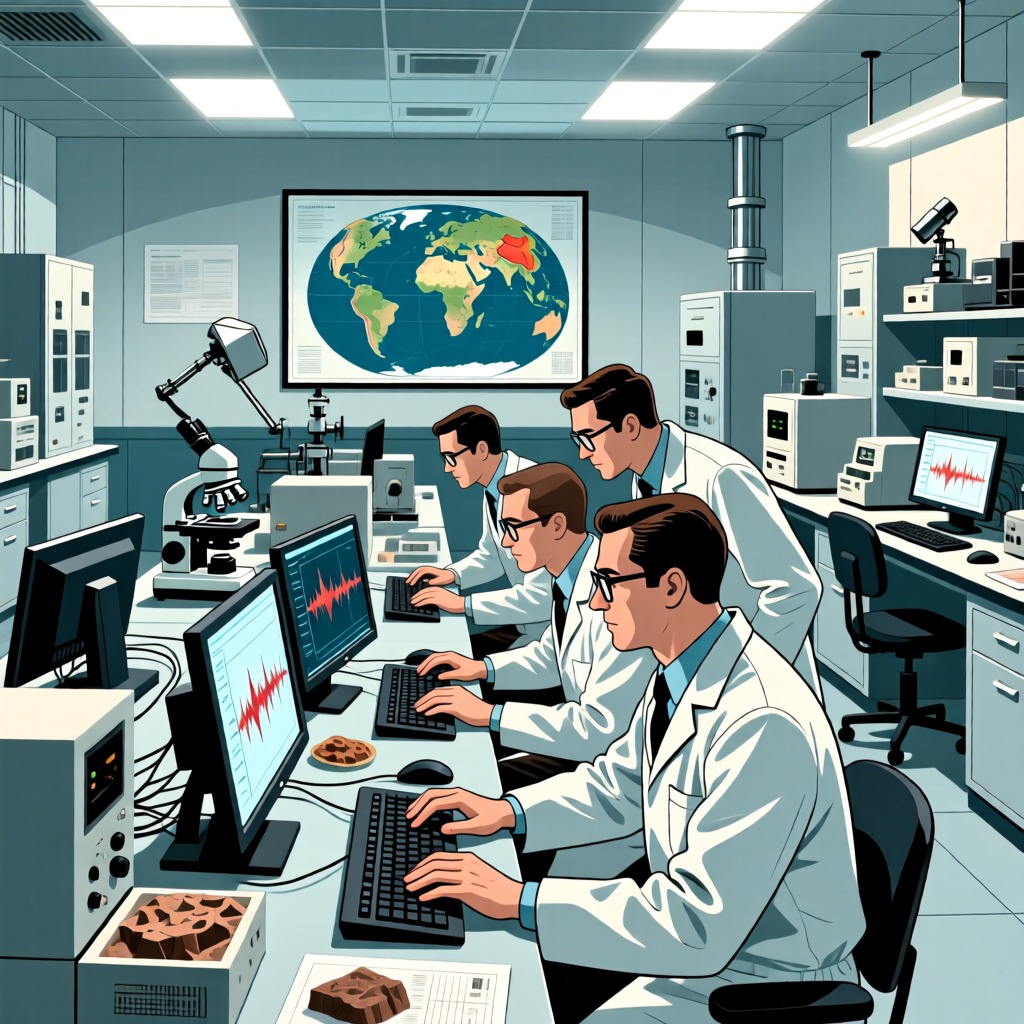

The structure of the Earth's interior has long been a focal point of scientific exploration. In the 18th century, scientists calculated that the density of the Earth's interior was significantly higher than that at the surface, revealing the presence of heavy materials within the Earth. In the late 19th century, with the advancement of seismology, seismic waves became an important tool for studying the Earth's internal structure. Seismic waves are classified into primary waves and secondary waves, and their varying speeds reveal changes in the properties of materials within the Earth.
In 1909, Yugoslav seismologist Andrija Mohorovičić discovered that seismic waves refracted at a depth of 33 kilometers, establishing the boundary between the crust and the mantle, known as the Mohorovičić discontinuity. In 1914, American seismologist Beno Gutenberg identified the boundary between the mantle and the core, termed the Gutenberg discontinuity. These two boundaries are named after their discoverers.
The Earth's interior is divided into three layers: the crust, the mantle, and the core. The crust is the outermost layer, with an average thickness of about 17 kilometers, and is thicker in continental regions. Beneath the crust lies the mantle, which is divided into the upper and lower mantle. The upper mantle contains a zone of partial melting known as the asthenosphere, which may be the source of magma. The core is further divided into the outer core, which is mostly liquid, and the inner core, composed of iron-nickel alloy under extreme temperature and pressure.
In recent years, scientists have used seismic data and computer simulations to depict the complex structure of the Earth's interior. The surface of the core is filled with low-density fluids, resembling oceanic topography. Additionally, the temperature and pressure within the core are extraordinarily high, with the center temperature reaching 6880°C and pressure being astonishingly immense.
These discoveries enhance our understanding of the Earth's structure, yet we still cannot directly observe the Earth's interior. In the future, humanity may uncover more secrets about the inner workings of our planet.