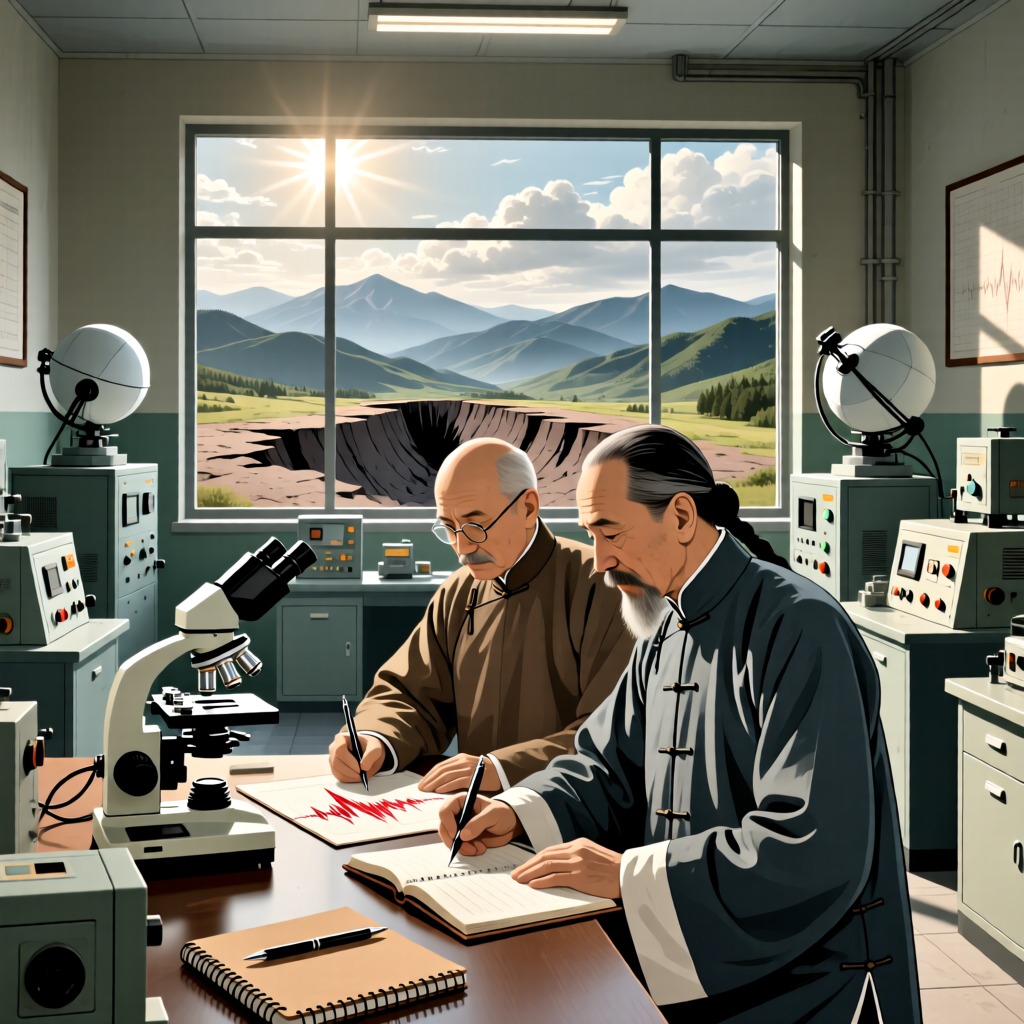
The secrets of the Earth's interior have always captivated human curiosity. Since the 18th century, scientists have gradually unveiled the mysteries of the Earth's interior through the study of seismic waves. Seismic waves are divided into primary waves (P-waves) and secondary waves (S-waves), which exhibit different propagation speeds when passing through various materials. In 1909, Mohorovičić discovered the Mohorovičić discontinuity, marking the boundary between the crust and the mantle. In 1914, the Gutenberg discontinuity was identified, signifying the boundary between the mantle and the core. The Earth's structure consists of three main layers: the crust, the mantle, and the core, with the core further divided into the outer core and inner core. The temperature and pressure within the core are extremely high, with scientists estimating temperatures reaching up to 6880°C and astonishing pressure levels. In recent years, researchers have utilized large-scale computer analyses of extensive seismic data to create an image of the core, revealing its surface filled with low-density fluids and a complex, dynamic structure.
Secrets of the Earth's Interior