
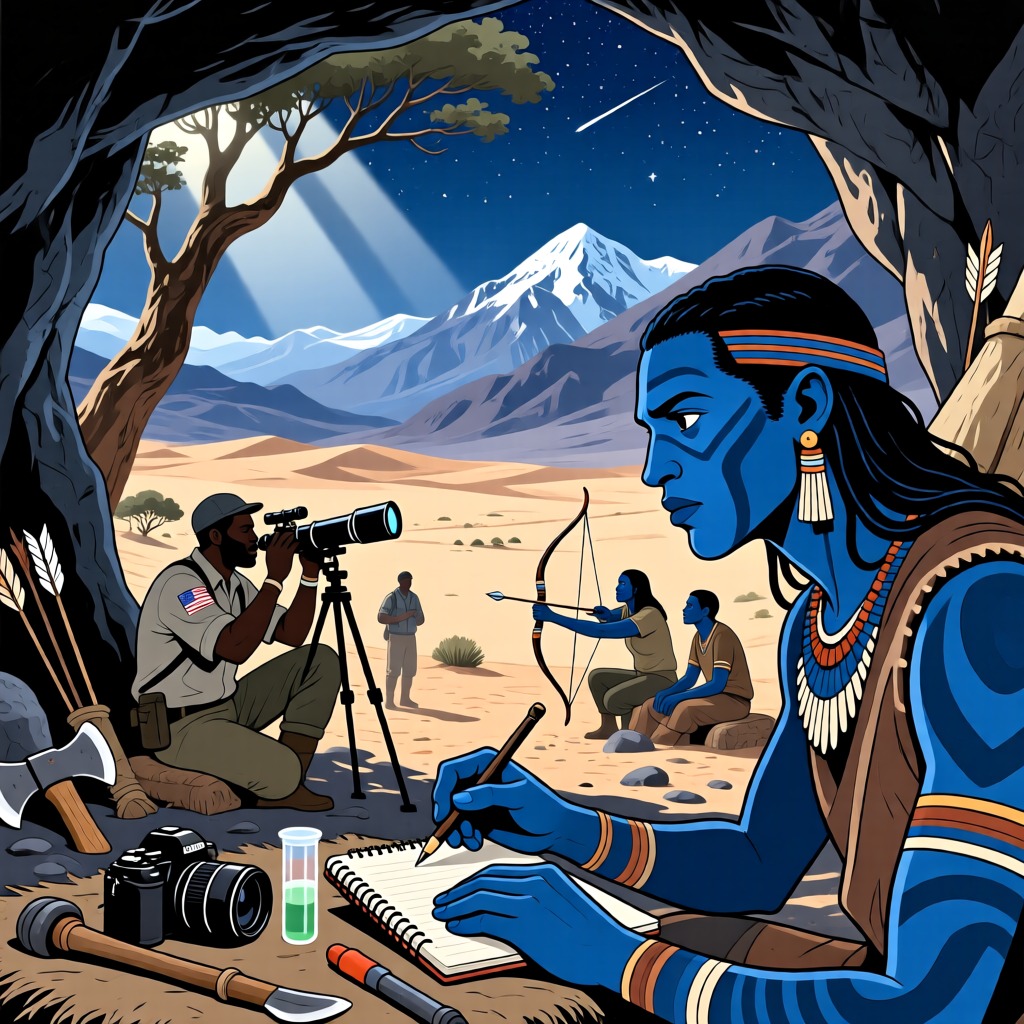

In the remote mountains of West Africa, a scientific expedition unexpectedly discovered a group of unique residents while exploring the natural vegetation and wildlife—they had a faint blue hue to their skin. These blue people live in caves and lead a primitive lifestyle, which astonished the expedition members. They decided to investigate further and ultimately found that not only was the skin color of these blue people unique, but their blood was also blue.
Subsequently, Dr. Wacey, a sports physiology expert from the University of California, found similar blue-skinned individuals in high-altitude regions of Chile. These people displayed remarkable adaptability in extreme environments, moving swiftly and seemingly unaffected by the low oxygen levels at high altitudes. Additionally, a few blue-skinned individuals have been recorded in the Sahara Desert and the Himalayas, where they also manage to survive in harsh conditions.
This series of discoveries has sparked widespread interest in the scientific community, leading to questions about traditional classifications of skin color. The existence of blue-skinned people challenges our understanding of human skin color diversity. Scientists are attempting to uncover the scientific principles behind this mysterious phenomenon, proposing various hypotheses. One theory suggests that the blood of these blue people contains a 'super high blood type protein,' which lacks the corresponding enzyme, resulting in both their blood and skin appearing blue. Another theory posits that this phenomenon may be linked to specific genes or due to changes in certain chemical components.
The existence of these blue-skinned individuals not only reveals the astonishing adaptability of humans to their environments but also provides new avenues for scientific research, inspiring further contemplation about human origins and evolution.