
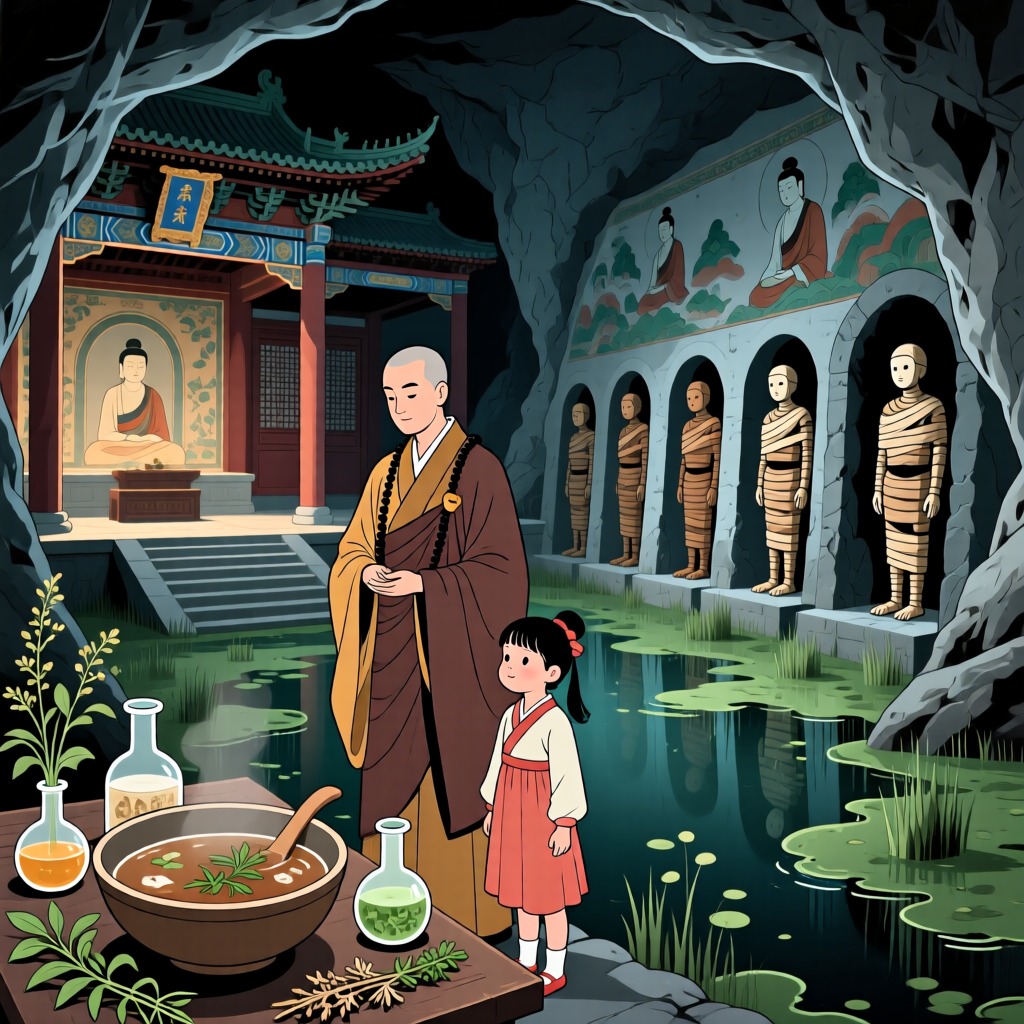

Throughout history, the phenomenon of human bodies not decaying has captivated the attention of scientists and medical professionals. What secrets lie behind these occurrences? Let us delve into the mysteries together.
In ancient China, there are numerous examples of monks preserving their physical forms using secret methods. One notable case is that of Master Yuanji, a monk from the Tang Dynasty. A month before his death, he stopped eating and consumed a self-made herbal soup. His body gradually became emaciated, yet his complexion remained rosy until he passed away. Remarkably, a month later, his body not only showed no signs of decay but also emitted a fragrant aroma. His disciples believed this was the result of the monk's immense virtue, leading them to build a temple in his honor, which has continued to attract worshippers for a thousand years.
In the 1930s, Japanese spies stole Master Yuanji's body, turning it into a national treasure of Japan. The monk's body sat cross-legged with a lifelike appearance, as if he were still alive. Experts analyzed that his body was saturated with preservatives, which may be one reason for its millennium-long preservation.
In the marshes near Manchester, England, researchers discovered another ancient corpse that had not decayed. Tests revealed that special chemicals in the marsh played a role in preservation. In such muddy environments, bacteria struggle to survive, allowing the body to remain intact.
On the island of Sicily in Italy, an ancient cave containing 8,000 mummies has been found. Among them, the mummy of a 4-year-old girl named Rombaltera Lazzaria is particularly striking. Her mother sought the help of a renowned physician, Salafia, who used various agents for special preservation treatment. Over eighty years later, the girl still appears remarkably lifelike.
These unsolved mysteries await further exploration and answers.