
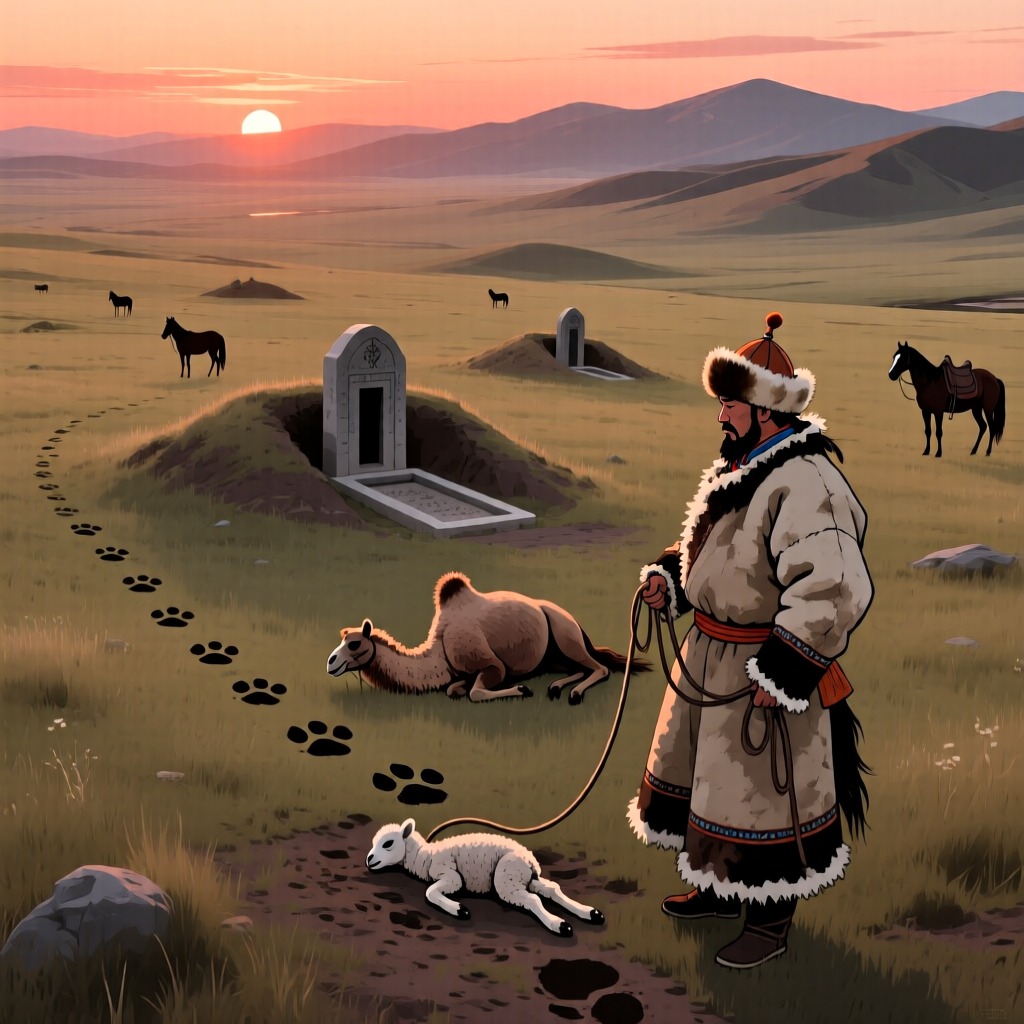

The mystery surrounding Genghis Khan's burial site has intrigued historians for centuries. While there are various theories about the location of his death, the most credible suggests he passed away in present-day Qing County, Gansu Province. However, the exact location of his tomb remains an enduring enigma. The Mongolian tradition of burial involves no visible graves; instead, they fill the grave with earth and cover it with grass to maintain a flat surface. This unique burial practice has made it incredibly difficult for future generations to locate his final resting place.
According to the historical text "The Secret History of the Mongols," Mongolian burial customs do not leave behind mounds; instead, they flatten the ground using horses. Ye Ziqi, a writer from the late Yuan Dynasty, described in his work "The Book of Plants and Trees" how after a Mongolian emperor's death, the body would be transported to the northern desert for deep burial, followed by the flattening of the ground with thousands of horses until grass grew over it, at which point the site would be sealed. During memorial ceremonies, a camel lamb would be brought and killed in front of its mother, with the blood spilled on the grave site. If the mother camel wandered and cried for a long time, it was believed that this indicated the location of the tomb.
This secretive burial practice starkly contrasts with the grand mausoleums built by emperors of other ancient Chinese dynasties. Not only Genghis Khan, but all rulers of the Mongol Empire have left no trace of their burial sites to this day.