
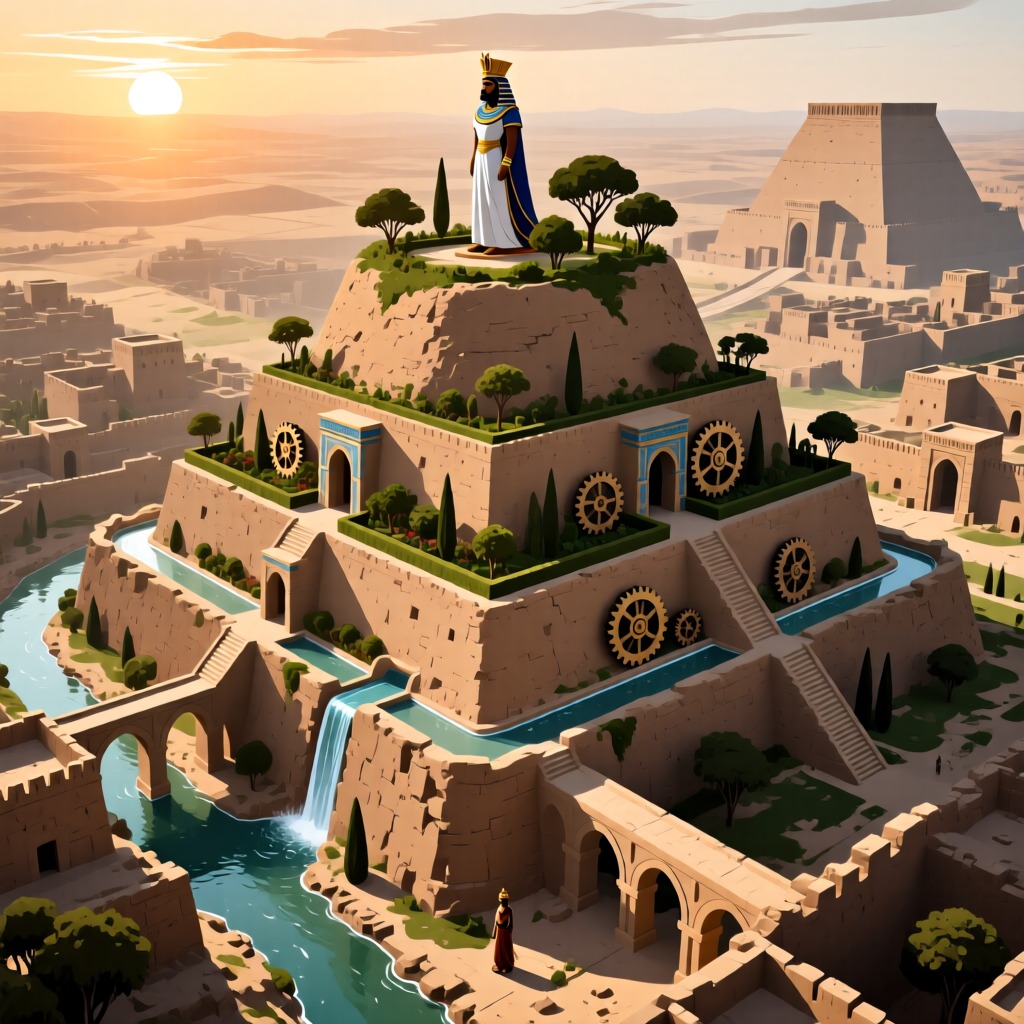

Over 2,500 years ago, a Greek scholar listed the Seven Wonders of the World, which included the Hanging Gardens of Babylon. This legendary garden, said to have been built between 604 and 562 BC in the Babylonian Empire, was constructed by King Nebuchadnezzar II for his queen, Amytis, who longed for the greenery of her homeland. The Hanging Gardens were described as a four-tiered mound covered with lush vegetation and trees, seemingly suspended in the air, hence the name. However, as time has passed, historians have raised many questions about the authenticity and location of the gardens. Despite archaeological evidence supporting their existence, the exact location and construction methods remain an unsolved mystery.
Archaeologist Robert Koldewey discovered clues supporting the existence of the Hanging Gardens, including stone arches and a possible water-lifting device. Experts speculate that the gardens required a complex irrigation system, operated by slaves who turned gears to raise water to the top tier, which was then used to irrigate the plants through artificial channels. Nevertheless, these theories still await further verification.