
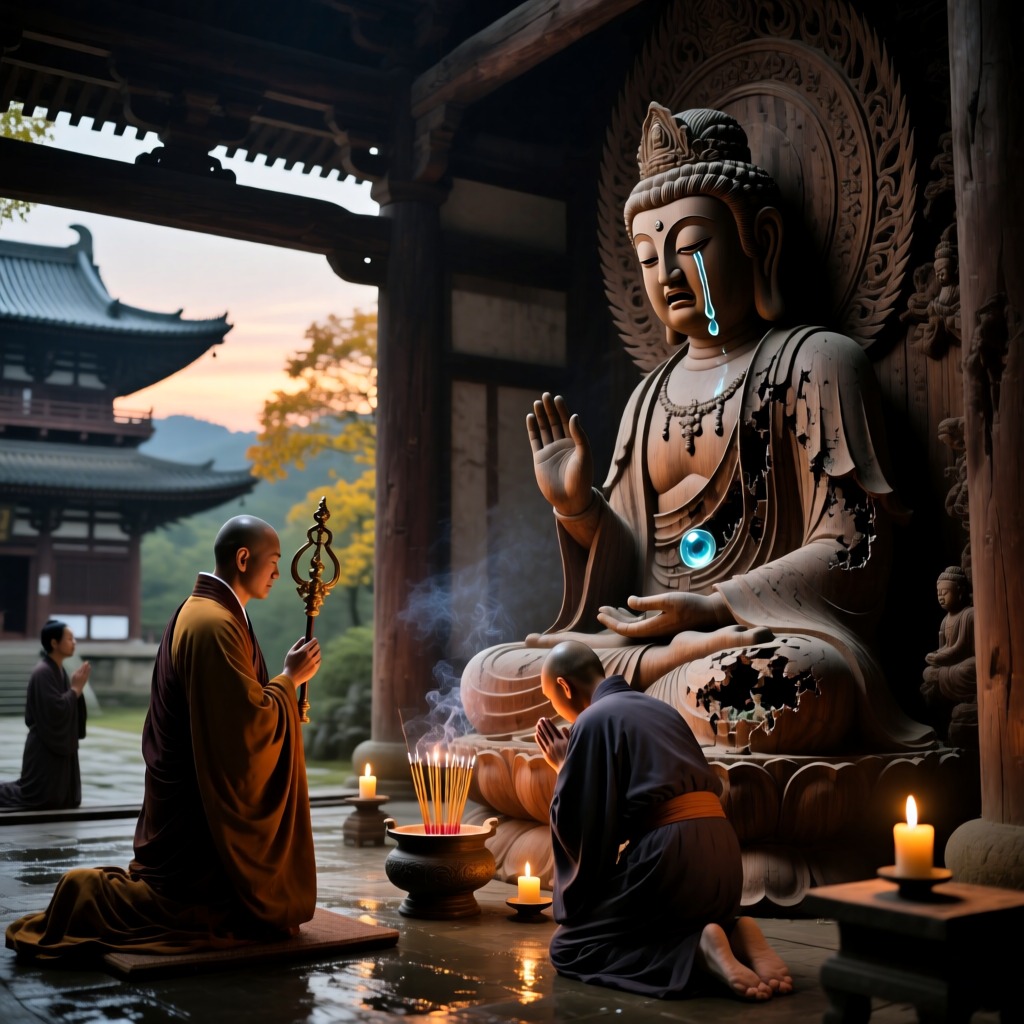

In the Chuguji Temple in Nara, Japan, there is a statue of Kannon Bodhisattva carved from an entire cypress tree. In the autumn of 1987, devotees noticed tears streaming from the eyes of the Kannon statue, which attracted widespread attention. The government even dispatched police to maintain order in response to the overwhelming crowds. Scientists also got involved, attempting to uncover the truth behind this millennia-old phenomenon of the Bodhisattva weeping. After thorough investigation, they discovered that the tears were not a manifestation of divine compassion but rather a result of the cypress wood absorbing moisture, causing water vapor to condense into droplets on the statue's eyes. This revealed a scientific explanation rather than a supernatural occurrence.
Similarly, at the Ersheng Temple in Gong'an County, Hubei Province, China, there are reports of a similar mysterious phenomenon. The temple houses statues of the Qingyeji Tathagata and Lu Zhide, which also weep due to the humid environment. The eyes of these statues are made of crystal, and as humidity increases, water vapor condenses within them, forming what appears to be tears. This phenomenon is not rare; the statues at Ersheng Temple may weep throughout the year, except in winter.
In Vietnam's Tava Temple, a statue also wept in the summer of 1987. This statue was actually a real human body treated with preservatives. Over time, the preservation methods failed, and the internal organs began to decay, resulting in fluid leaking from the eye sockets. This discovery prompted a reevaluation of ancient mummies and revealed the scientific truths behind these mysterious phenomena.