

Around 4 PM on the second day, we rented a jeep to head towards Lake Titicaca. The vehicle navigated through the bustling traffic of La Paz, Bolivia's capital, passed through slums, climbed onto the high plateau, and entered vast, open spaces. Along the roadside were repair shops and heaps of discarded materials; the further south we went, the sparser the houses became, until human presence was nearly nonexistent. Outside the window, endless grasslands stretched to the horizon, connecting with the snow-capped peaks of the Real Mountains, creating a magnificent landscape. However, there was an ethereal atmosphere, as if entering a mythical realm.
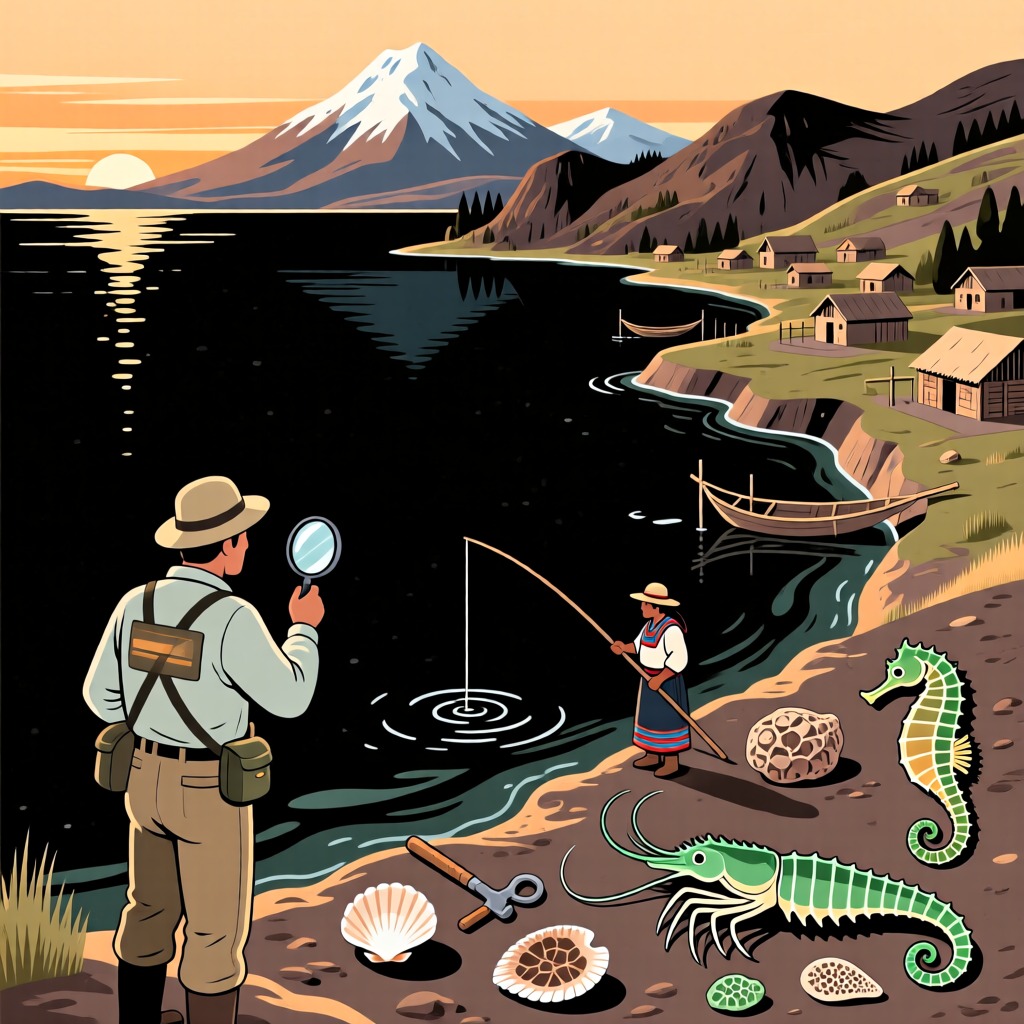
Lake Titicaca, located on the border between Bolivia and Peru, sits at an elevation of about 12,500 feet and covers an area of 3,200 square miles. The lake is scattered with marine shell fossils, indicating that this plateau was once underwater. Experts speculate that around 100 million years ago, geological shifts caused the entire plateau to rise from the seabed, forming what is now the South American continent. During this process, a significant amount of seawater, along with marine life, was carried up into the Andes Mountains.
Surprisingly, Lake Titicaca still harbors marine fish species, such as seahorses. The discovery of green hook shrimp and other marine organisms in the lake provides evidence that the water was once rich in salt, even originating from the ocean. Today, the terrain around Lake Titicaca continues to change, with the northern side rising higher and the southern side lower. The city of Tiwanaku, once a lakeside port, is now displaced 12 miles from the shore, sitting over 100 feet above the lake's edge. This indicates significant changes in the surrounding terrain since the establishment of Tiwanaku.
Mainstream historians believe that Tiwanaku was built after 500 AD, but another group of scholars, based on mathematical and astronomical calculations, suggests its construction date could be as far back as 15,000 BC. This implies that Tiwanaku may have thrived during the last Ice Age in prehistory.