
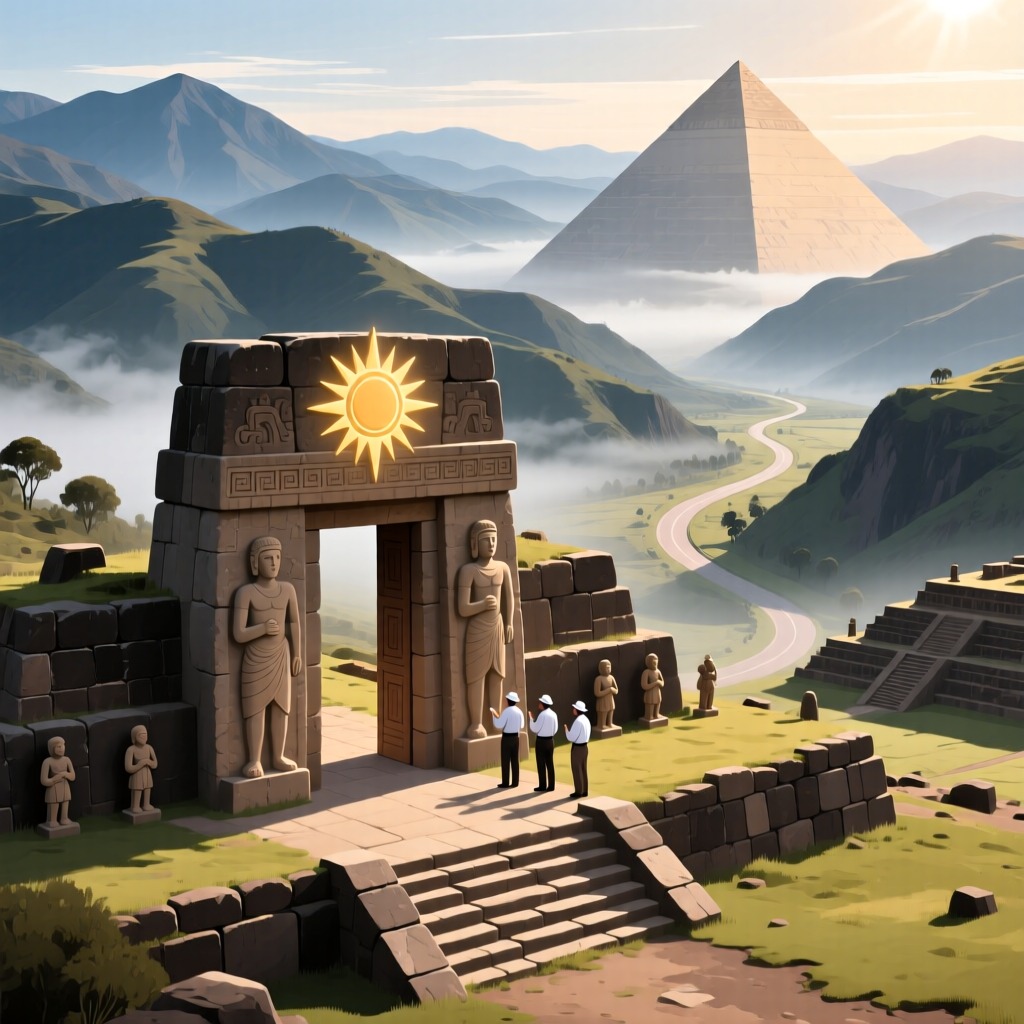

Located 21 kilometers southeast of Lake Titicaca on the Andean Plateau, there stands a pre-Incan archaeological site from the Tiwanaku culture. This site was once a crucial passageway from the Pacific coast to the interior, leaving behind a series of stunning structures. Among them, the most striking is the grand monument known as the Gate of the Sun.
The Gate of the Sun stands 3.048 meters tall and 3.962 meters wide, carved from a single massive piece of andesite. The central lintel features a shallow relief of a human figure radiating multiple beams of light, with each hand holding a staff. Flanking this figure are three rows of 48 smaller figures, with the upper and lower rows depicting warriors facing the deity, while the middle row features anthropomorphized birds. This colossal stone accurately greets the first rays of dawn.
There are various theories regarding the builders and the construction date of the Gate of the Sun. Some believe it was built by the Incas or the Aymara, while others argue that it predates them, attributing its creation to the sun god Viracocha. Some even suggest that the gate was constructed 13,000 years ago and transported from a quarry 5 kilometers away using flat-bottomed boats. However, these claims remain part of local mythology.
Through archaeological research, the exact date of the Gate of the Sun has been established as between 300 and 700 AD, with the builders likely being the Kollas of the Andean region. The Gate served not only as a religious structure but also as a commercial and cultural center, with steps leading to a central market, and its carvings symbolizing the authority of rain and the rain god.
Despite the many mysteries surrounding it, the enigmatic allure of the Gate of the Sun continues to attract countless scholars and tourists eager to explore its secrets.
