
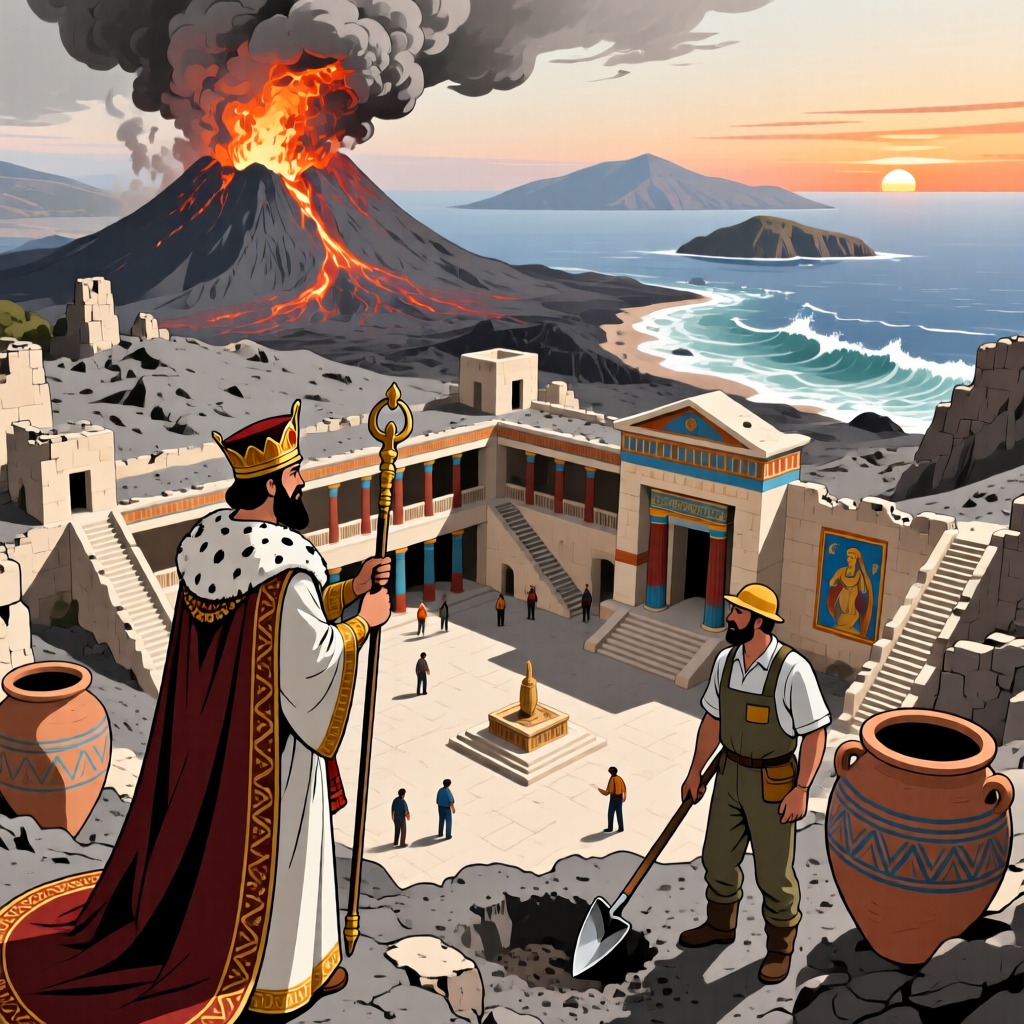

Why was the Knossos Palace destroyed? This question has puzzled scholars for a long time. In Greek mythology, King Minos waged war due to the murder of his son, forcing Athens to send young boys and girls to Crete periodically. However, archaeologists have discovered the largest palace ruins of the Minoan civilization on Crete—Knossos Palace. This palace was not only the center of politics, economy, and culture but also had a strong religious significance. The new palace, discovered by Evans, was built around 1700 to 1500 BC and covers an area of 22,000 square meters, featuring over 1,500 rooms. The central courtyard is spacious, with living quarters to the east and offices and ritual spaces to the west. Yet, around 1500 BC, this prosperous city was suddenly destroyed, and the reasons remain unclear.
Later, archaeologists found that around 1500 BC, the Santorini volcano, located about 70 kilometers north of Crete, experienced one of the most severe volcanic eruptions in human history. The volcanic ash covered the cities on the island, and the resulting tsunami destroyed all buildings on Crete. This disaster not only sealed the fate of the Knossos Palace but also buried an ancient civilization.