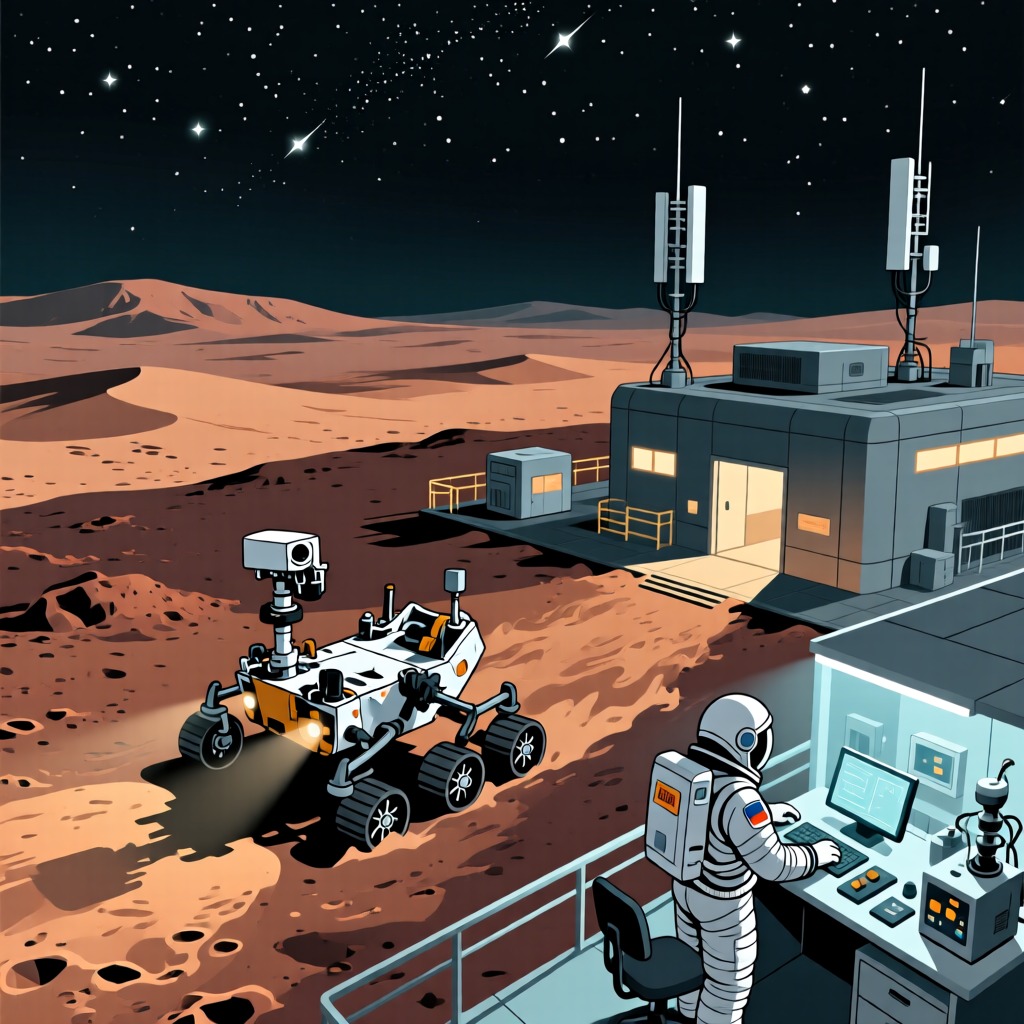
Mars, as a planet in our solar system, has always captivated human curiosity. Its diameter is about half that of Earth, and it has a slightly longer rotation period, along with seasonal changes similar to those on Earth. Over three hundred years ago, the polar ice caps of Mars were first discovered, which was considered evidence of significant water presence on the planet. In 1877, Italian astronomer Giovanni Schiaparelli observed lines on the surface of Mars, mistakenly believing they were canals made by intelligent beings. However, the existence of these lines has never been widely accepted by scientists. It wasn't until the 1960s, with advancements in space technology, that humans had the opportunity to observe Mars up close. Early photos taken by the Mariner 4 spacecraft showed a pockmarked, desolate, and dry surface. The subsequent Mariner 9 mission revealed clues that Mars may have once experienced warmer periods and had dried-up riverbeds. In 1975, the Viking spacecraft successfully landed on Mars, collecting soil samples and conducting a series of biological experiments, ultimately confirming that no signs of life were found. Nevertheless, the debate over the existence of life on Mars continues.
The Secrets of Mars