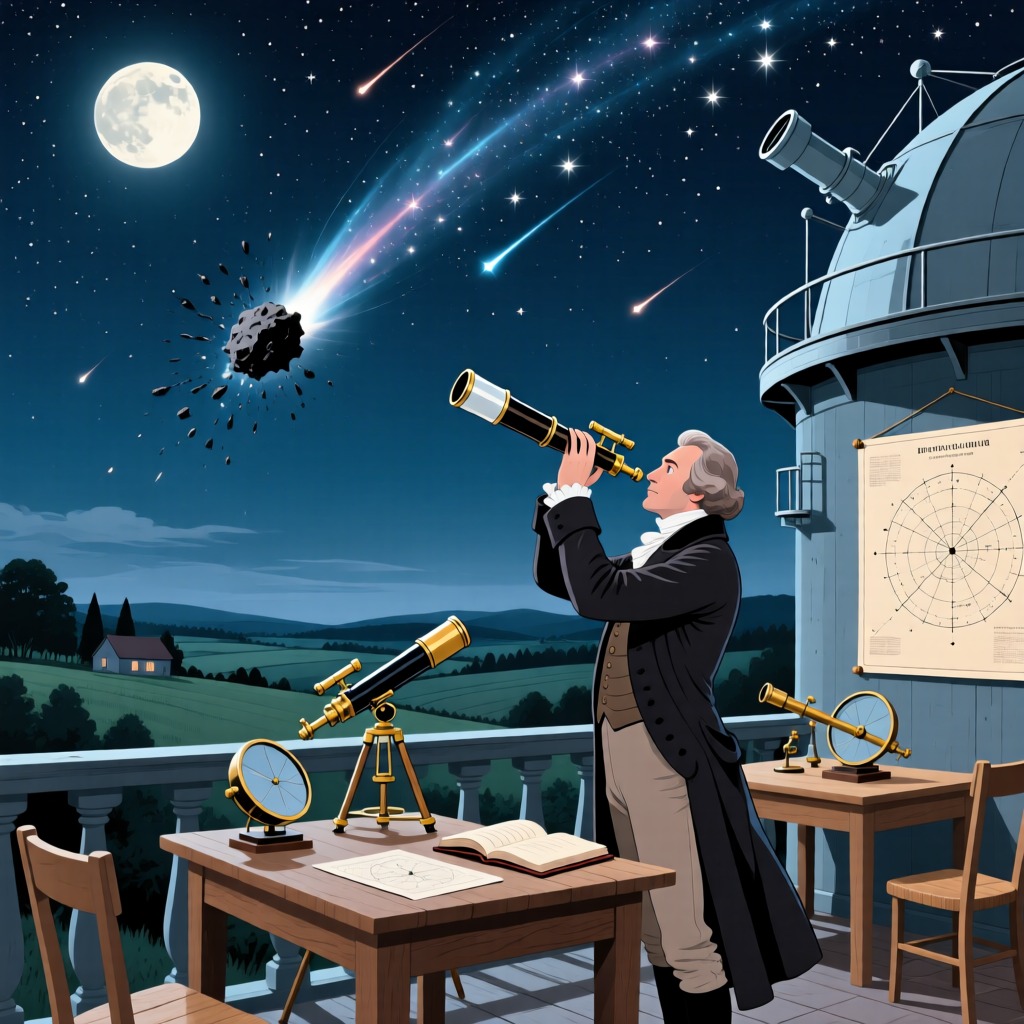
The story of Biela's Comet reveals an astonishing secret of the universe. It not only witnessed the splitting and disintegration of a comet but also showcased the process of meteor shower formation. In 1846, Biela's Comet split into two parts, which gradually drifted apart over time, eventually forming two independent comets by 1852. However, they failed to return as expected in 1872, and instead, a spectacular meteor shower lit up the night sky on November 27. This meteor shower radiated from the constellation Andromeda, lasted for six hours, and produced approximately 160,000 meteors, peaking at tens of thousands per hour.
The fall of Biela's Comet and the secret of meteor showers not only illustrate the patterns and evolutionary history of comet splitting and disintegration but also reveal the close relationship between comets, meteor streams, and meteor showers. A similar example is the Leonid meteor shower, which is associated with the Tempel-Tuttle comet and erupts every 33.5 years. The Leonid meteor storm on November 13, 1833, saw over 240,000 meteors, astonishing observers at the time. In the 1960s, the Leonids also produced impressive meteor showers, with meteor counts reaching 140,000 per hour, lasting for eight to nine hours. These phenomena remind us that the intersection of Earth's orbit with that of meteor streams determines the timing and frequency of meteor showers.