
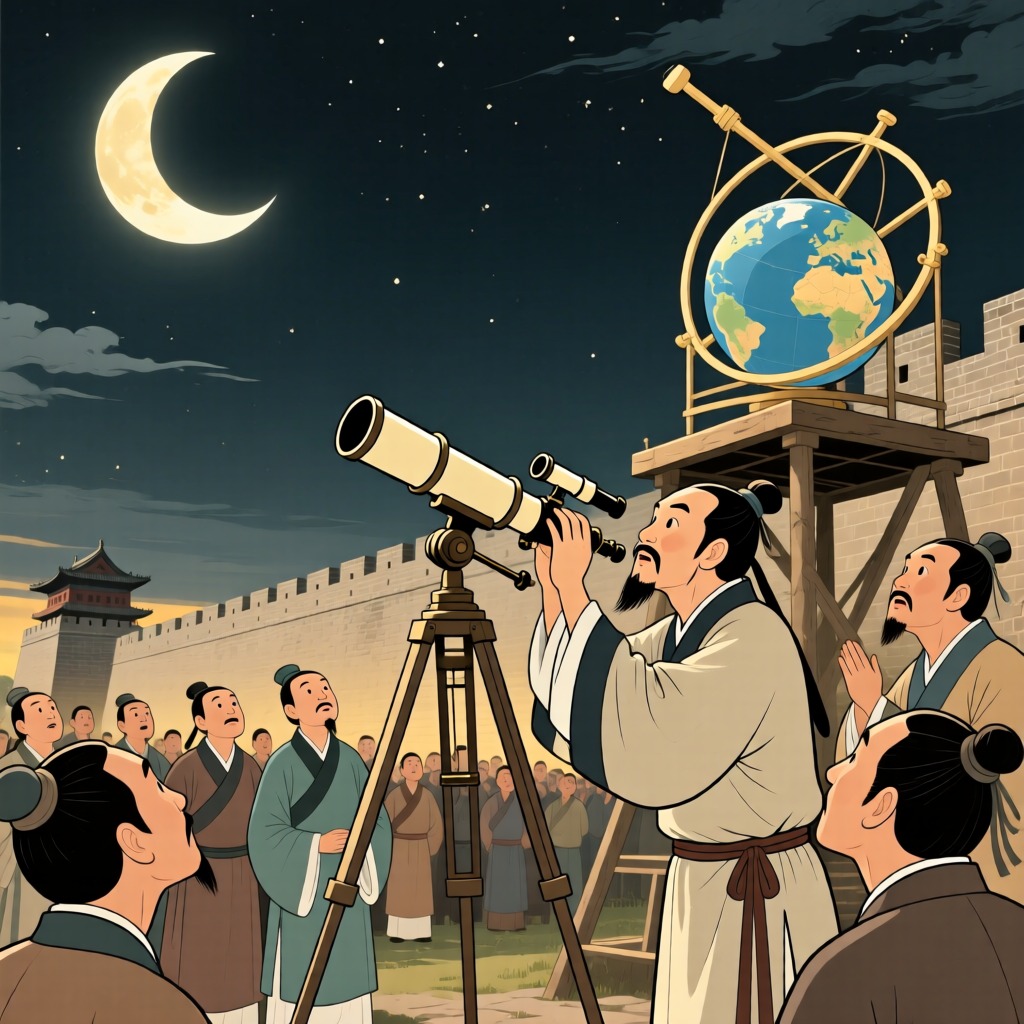

Eclipses have always captivated people's attention. During a solar eclipse, the sun is obscured by the moon, as if a celestial dog is devouring the sun. Conversely, during a lunar eclipse, the moon is shrouded in the Earth's shadow on a full moon night, gradually dimming until it disappears. These phenomena have evoked mystery and fear since ancient times.
In ancient times, people believed that a solar eclipse was caused by a celestial dog eating the sun, prompting them to beat drums and clang gongs to scare the dog away. Columbus famously took advantage of this superstition to persuade indigenous people to provide him with food. Eclipses not only caused panic in ancient times but continue to be a focal point of study for astronomers today, helping to explore the movements of the sun and moon.
The moon orbits the Earth, while the Earth, along with the moon, orbits the sun. The moon itself does not emit light; it merely reflects sunlight. As the moon moves, the shape of the visible moon's surface changes continuously, transitioning from new moon to full moon, then to last quarter, and back to new moon. This cycle follows a period of approximately 29.5 days, known as a synodic month, which served as the foundation for early calendars.
The conditions for solar and lunar eclipses differ. A solar eclipse occurs during the new moon phase when the moon is positioned between the Earth and the sun, blocking sunlight. In contrast, a lunar eclipse occurs during the full moon phase when the Earth is between the sun and the moon, obstructing sunlight from reaching the moon. The duration of solar and lunar eclipses varies; solar eclipses typically last only a few minutes, while lunar eclipses can last for several hours.
In the 20th century, a total solar eclipse occurred in the Mohe region of China, attracting numerous astronomy enthusiasts. A solar eclipse is an ideal opportunity to observe the solar chromosphere and corona, aiding in the study of solar radiation changes and lunar motion theories. However, since the path of a solar eclipse only covers specific areas, many people may go their entire lives without witnessing one. In contrast, lunar eclipses occur at night and can be seen across entire hemispheres, leading people to believe that lunar eclipses are more common.
There are at least two solar eclipses each year, but the path of totality only covers limited areas. Lunar eclipses occur at night and can be seen by entire hemispheres, which is why people often mistakenly think they happen more frequently than solar eclipses. In reality, the frequency of lunar eclipses varies by year, with some years experiencing none at all.
