
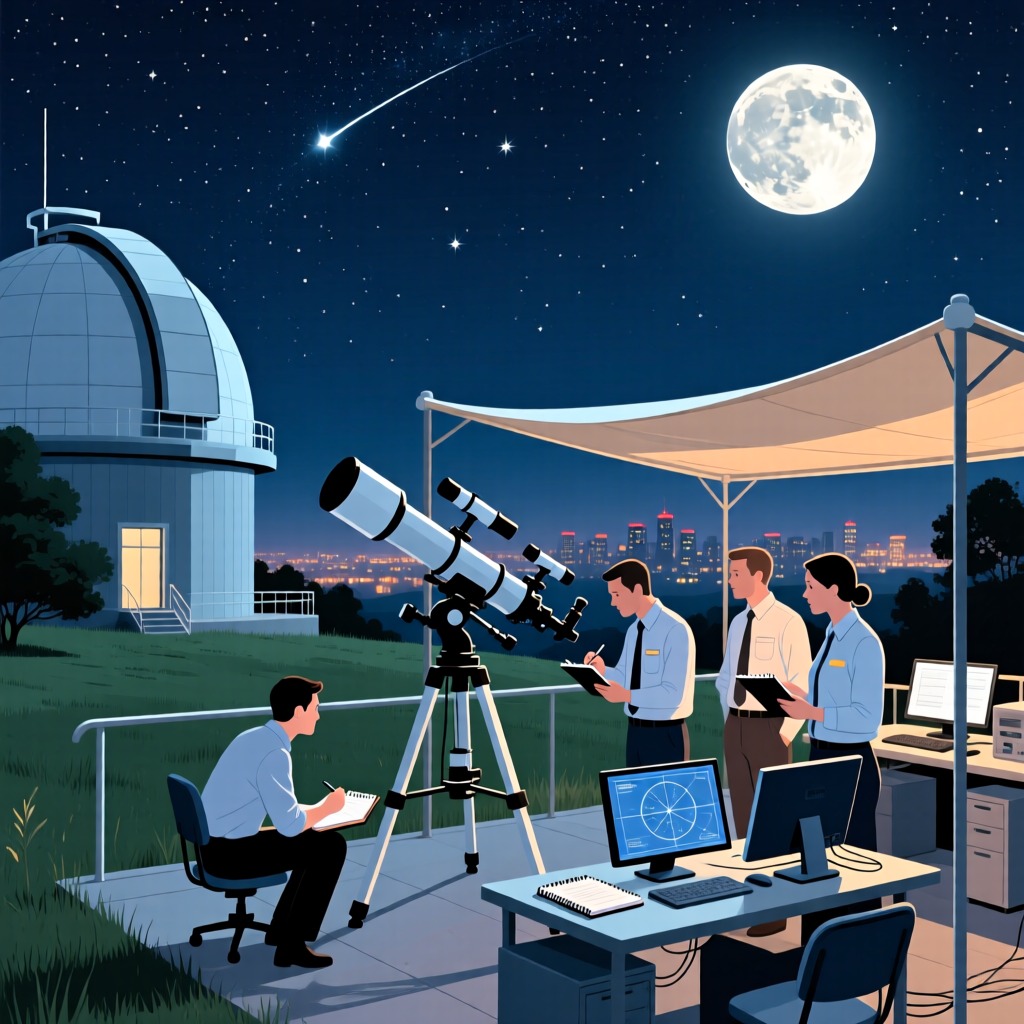

Where did the Moon come from? This has always been a mystery in the minds of astronomers and scientists. The Moon has many unique characteristics compared to other satellites, making it difficult for humanity to understand its origin.
**Fission Theory**
One hypothesis is the 'Fission Theory,' which suggests that the Moon split off from the Earth. It is claimed that in the early days of Earth, the planet was spinning very rapidly, causing material on its surface to gradually bulge and eventually break away to form the Moon. However, there is currently no evidence to support that the Earth ever spun at such high speeds.
**Capture Theory**
Another hypothesis is the 'Capture Theory,' which posits that the Moon was originally a small asteroid orbiting the Sun and was captured by Earth's gravity to become a satellite. This theory can explain the differences in composition and density between the Moon and Earth, but the likelihood of Earth capturing such a large celestial body is extremely low.
**Co-formation Theory**
There is also the 'Co-formation Theory,' which suggests that the Moon and Earth originated from the same nebula, but due to different formation times, the Moon is primarily composed of non-metallic materials. While this hypothesis can explain some phenomena, many mysteries remain unsolved.
Scientists believe that the Moon is not only key to unlocking the mysteries of Earth and the universe but also an important clue in unraveling the origins of the solar system. Despite numerous hypotheses, the true origin of the Moon remains an unresolved mystery.
