
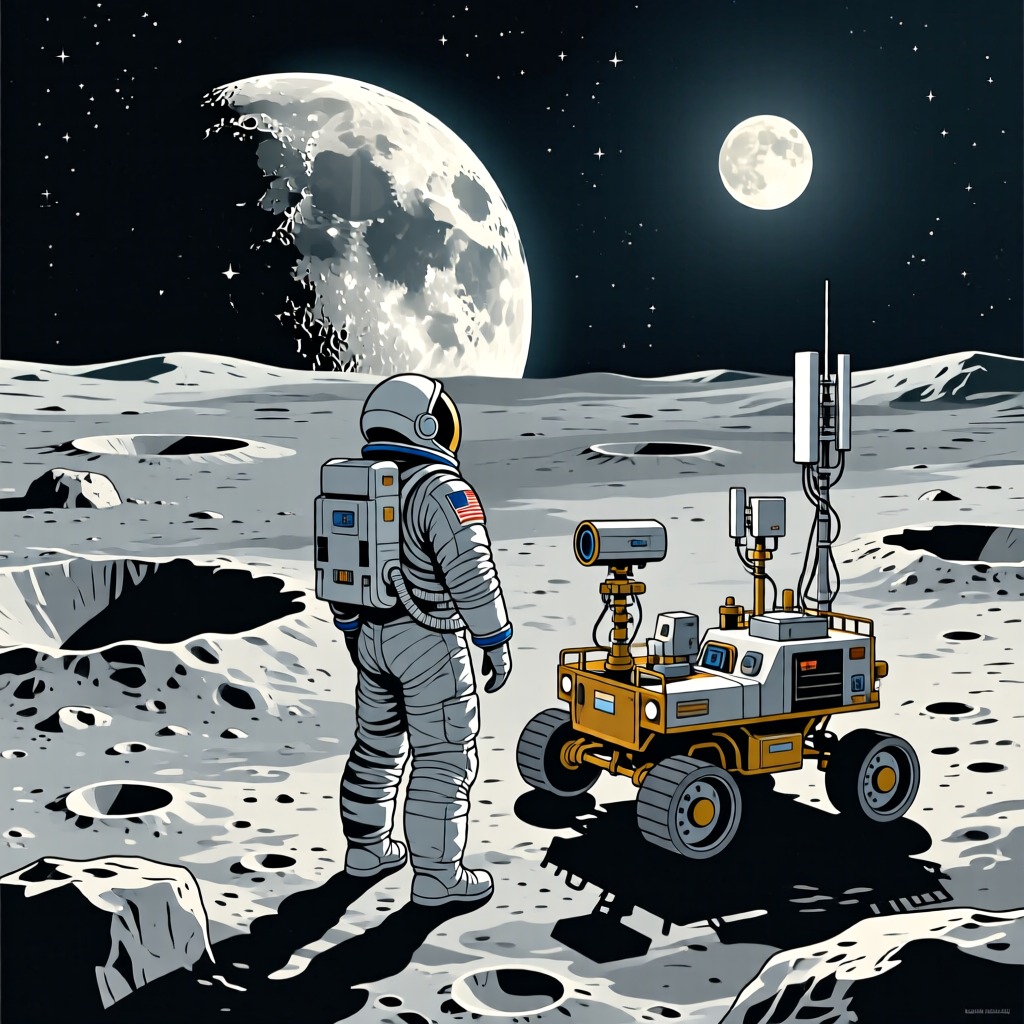

The Moon has always been a mysterious presence in the hearts of humanity. In 1969, Neil Armstrong and others successfully landed on the Moon, unveiling its enigmatic facade. Unlike Earth, the Moon lacks lakes, oceans, and rivers, and even has no atmosphere, making it appear exceptionally silent and desolate.
As Earth's closest neighbor, the Moon is about 380,000 kilometers away and has a diameter of only 3,474 kilometers. It rotates slowly, with a rotation speed that is just 1/13 that of Earth, while orbiting Earth in an elliptical path. Due to the synchronization of its rotation and revolution periods, we can only see one side of the Moon from Earth, a phenomenon known as the "tidal locking effect." It wasn't until 1959, when the Soviet Luna 3 probe captured the first images of the Moon's far side, that humanity glimpsed the true appearance of the Moon's hidden hemisphere.
The alternation of day and night on the Moon is extremely prolonged, equivalent to two weeks on Earth. On the Moon, gravity is only one-sixth that of Earth, allowing for jumps of over 20 meters and making walking feel like floating. These peculiar phenomena have made the Moon a hotspot for human exploration.
Although some secrets of the Moon have been partially unveiled, many unsolved mysteries still await our exploration. Future plans for lunar tourism, colonization, and various exploration bases may soon become a reality.
