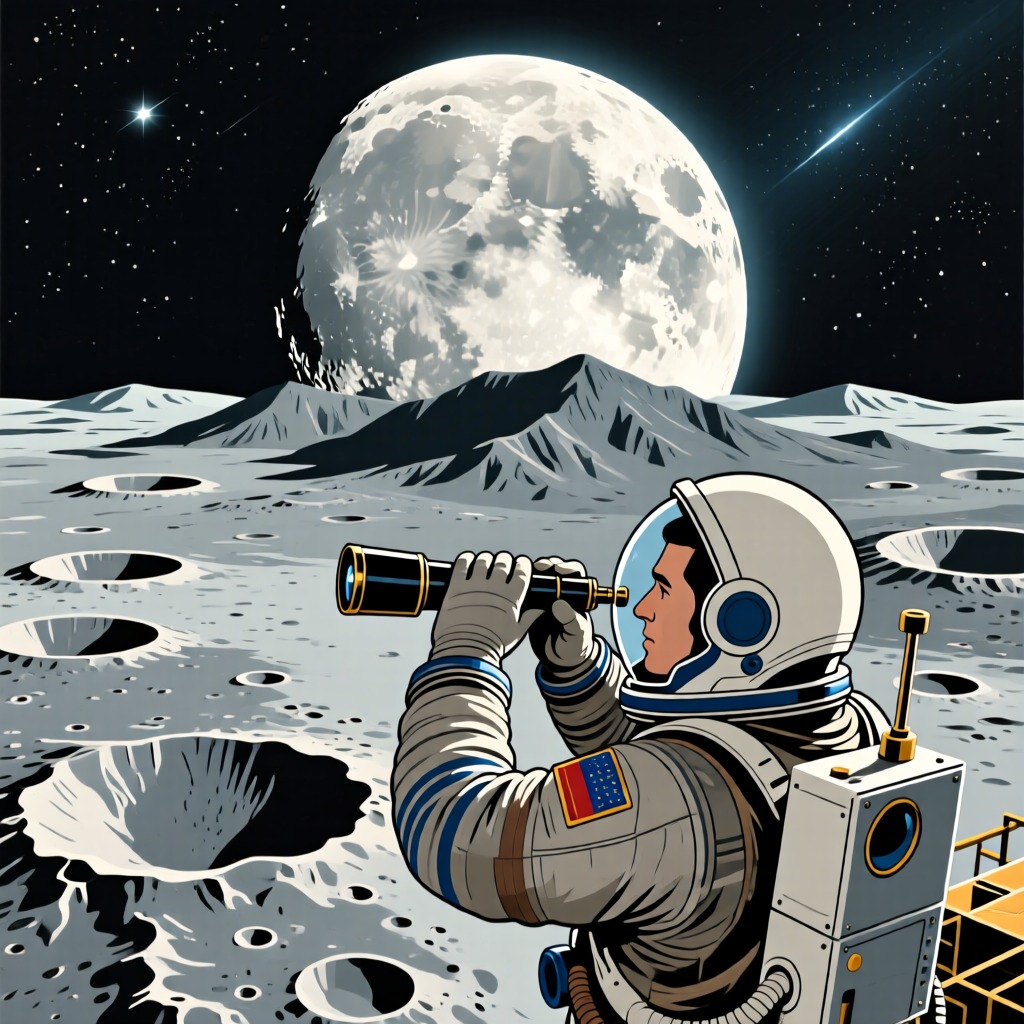

For centuries, people have gazed at the moon, always seeing the same face. It wasn't until 1959 that the Soviet Union's Luna 3 spacecraft revealed the appearance of the moon's far side for the first time. What secrets lie behind this hidden landscape?
The reason we can only see one side of the moon is that its rotation period is the same as its orbit around the Earth. However, due to the tilt of the Earth's orbit relative to the moon's orbit, the moon's poles briefly face the Earth each month, allowing us to observe a small portion of the far side. For most of the time, though, the far side remains elusive.
The photographs from 1959 unveiled the mysteries of the moon's backside. Scientists discovered that the terrain there is vastly different from that of the near side. The far side lacks the so-called "maria" and is instead dominated by numerous mountains, while the near side features most of the "seas" and other depressions. The reasons behind this disparity remain an unsolved mystery. Some believe that the moon's surface is affected by Earth's gravitational pull, creating "solid tides" that lead to the differences between the two sides; others suggest that temperature variations could be a key factor. As technology advances, more secrets of the moon's far side await our exploration.