
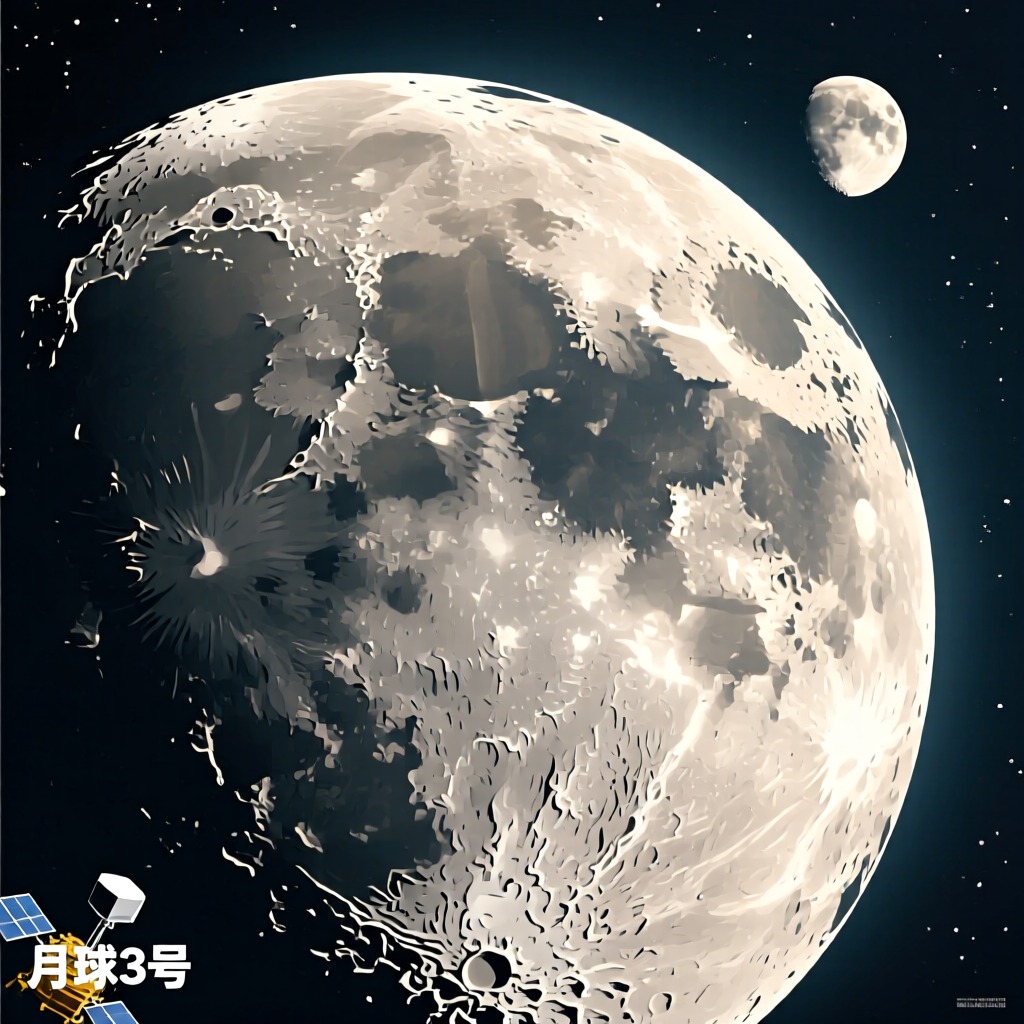

Since ancient times, people have gazed at the moon, yet they have always seen only one side. What secrets lie behind this? It turns out that the moon's rotation period is synchronized with its orbit around the Earth, which is why we can only see one half of it. Nevertheless, imaginations about the far side of the moon have never ceased. Some speculate that there might be air and water there, or even vast craters and dark plains. It wasn't until 1959, when the Soviet probe Luna 3 captured the first images of the moon's far side, that its mysteries began to unfold.
The terrain on the far side of the moon is complex and varied; the central region lacks the so-called "seas" and is instead covered with mountains. In contrast, the "seas," "lakes," "swamps," and "bays" are predominantly found on the near side, while the far side is mainly mountainous. These differences have sparked extensive discussions among scientists, who are trying to find answers through studies of the moon's "solid tide," temperature variations, and more. As technology advances, our understanding of the moon continues to deepen, but many mysteries of the far side still await exploration.