
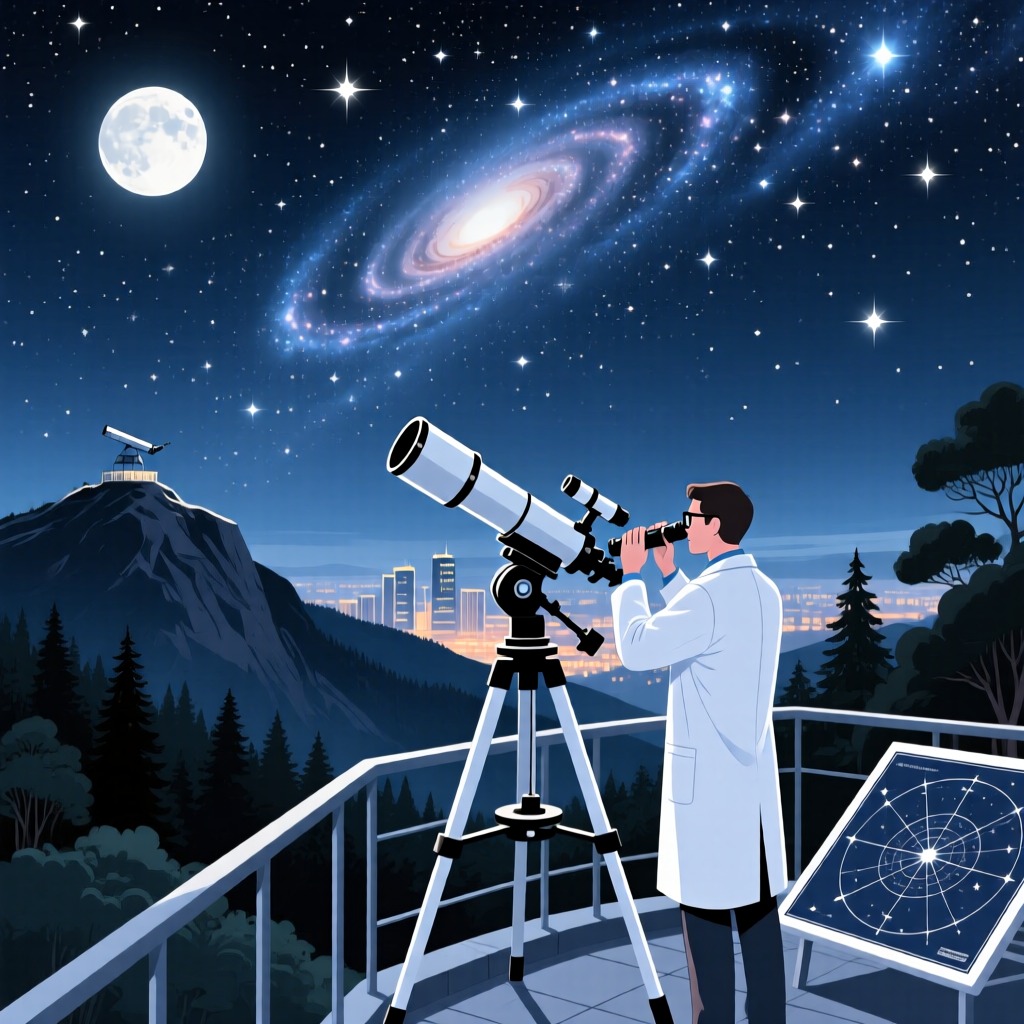

How vast is the universe? This is an ancient yet modern question. From the ancient skies to today's distant galaxies, humanity has been striving to answer it. If we compare the Sun to a pumpkin, the Milky Way is made up of countless such "pumpkin piles," which are distributed within an imagined "hollow sphere." This "hollow sphere" has a radius of 150 million kilometers, equivalent to the distance from the Earth to the Sun, known as an "astronomical unit." In this enormous "hollow sphere," our Earth is merely like a green bean.
Einstein's theory of general relativity tells us that the universe is finite yet unbounded, just as no matter which direction we walk on Earth, we can never find its edge. With advancements in technology, humanity has come to realize that beyond the Milky Way, there are many "extragalactic galaxies". These galaxies are extremely distant, and even through large telescopes, we can only see some blurry points of light.
From recognizing our own region on Earth to understanding the solar system and the Milky Way, humanity's perspective has continually expanded. Decades ago, the radius of the observable universe was only 10 billion light-years, but now it has reached 100 billion light-years. The size of the universe continues to expand, leaving many scientists perplexed. Einstein once "calculated" the radius of the universe to be 1 billion light-years, later revising it to 3.5 billion light-years. Today, the boundary of the observable universe remains unknown, as does its center.
